
Hey, everyone. I’m trying a new format for my weekly emails today. Five short and useful ideas, instead of one long essay. I think you’ll prefer it. Reply with your feedback :)
This is Coached Weekly, my career notes where I share the tiny % of ideas that work in real careers. It takes 5 minutes to read, but could speed up your career by years. I write this myself (no AI) and I read your replies. —Rohan Mahtani (LinkedIn)
Want to log in to Coached or see your personality assessments? Login.
01 / CAREER
What could you talk about for 40 minutes with no prep?
Do you know your answer to this?
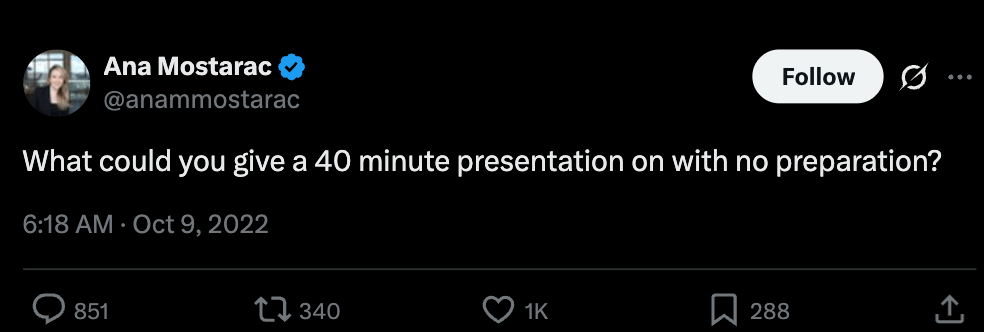
I love this question. A big part of figuring out your career is working out what you’re naturally good at and actually interested in, and that’s a very hard question to answer directly. This one’s a fun way of answering it.
Mine:
a) Making fuzzy stuff quantifiable. That’s how Resume Worded started (it codified fuzzy hiring manager likes and dislikes) and what Coached is doing with personality.
b) How to structure a joke. I love standup.
c) How to test a new idea very quickly. Every business I’ve started began here.
Once you have your own list, try to make your career include more of those things.
P.S. If you have a minute, reply with one of yours. I’m curious! :)
Something freaky cool worth trying: our research lab built this smart AI that:
finds what you’re good at
tells you what’s valuable vs your industry
gives you practical things you can say in intros, interviews, or on LinkedIn
It takes under a minute, and you’ll get polished things you can use your entire career, like a real coach sat down with you for weeks to find out what you’re good at: coached.com/superpower.
02 / MINDSET
The rules were made up by people
Steve Jobs once said: “Everything around you that you call life was made up by people that were no smarter than you. And you can change it, you can influence it.”
I agree. We take a lot of things as fact, but often one person wrote each of them, usually very quickly, often as a guess.
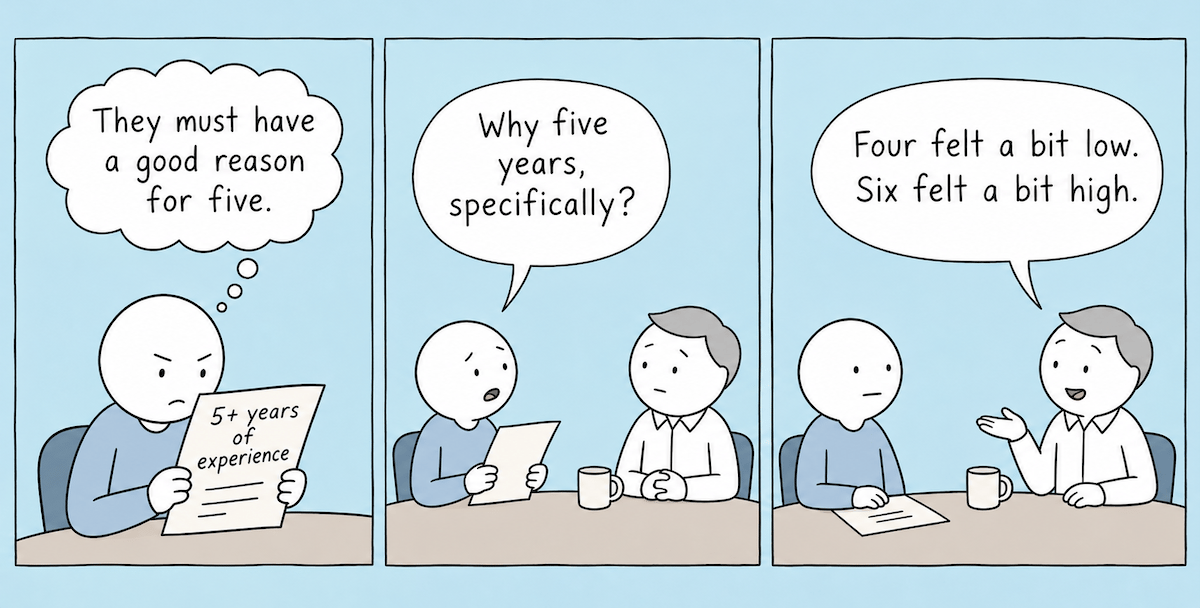
For example: a job posting says “5+ years of experience” and you have three. It reads like a hard line, so most don’t apply. But think about where the number came from. A hiring manager had a box to fill in and typed 5 because it sounded about right. They’d hire someone with three who can clearly do the job.
The same goes for the rules we carry around about what we’re allowed to do next. Like that you need experience in a field before you can get into it. Usually you can get that experience yourself, starting today. If you want to be a writer, you can start a blog.
So when a rule is in your way, find out who set it and ask whether it still has to be that way. Surprisingly often the honest answer is that it was made up!
03 / SELF-TALK
You’re worth something now
Early in his career, long before anyone bought a painting, Van Gogh wrote to his brother: “If I am worth anything later, I am worth something now. For wheat is wheat, even if people think it is a grass in the beginning.”
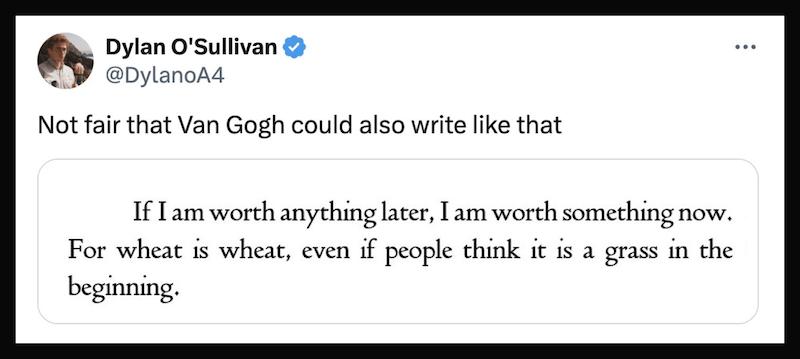
I love it. Most of us believe the opposite. I’ll believe I’m good at this when someone promotes me, publishes me, pays me for it. But recognition is slow. Our work was just as good the day before the promotion as the day after.
So don’t wait for the confirmation to act on it. Pitch the thing, quote the proper rate, go for the next role up. If you’re worth it later, you’re probably worth it now.
04 / STORYTELLING
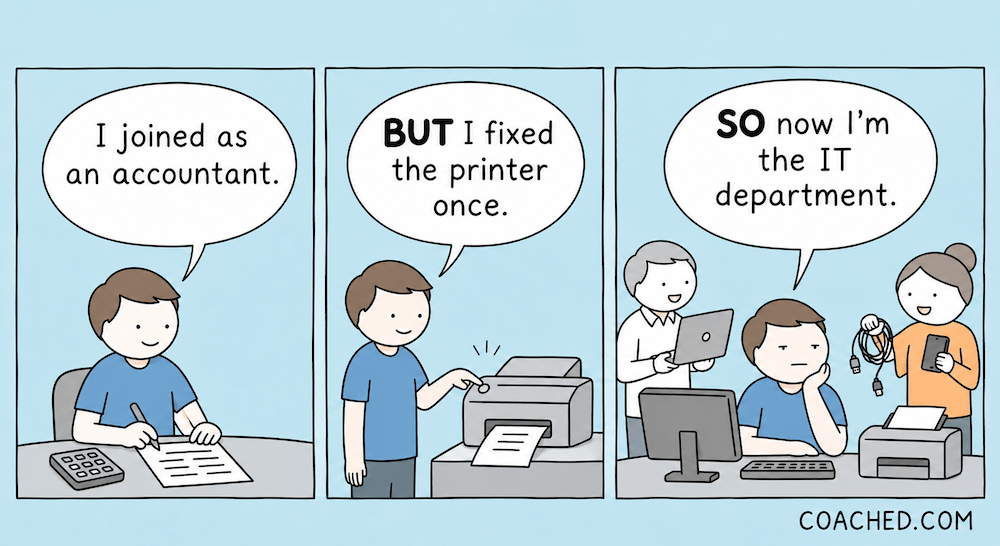
Join your story with “but” and “so”
The creators of South Park once explained how they check whether an episode is good. They write out everything that happens, one line per event, and look at the words that sit between the lines. If the lines are joined by “and then”, the episode is gonna be boring.
For example: Cartman gets a job, and then he goes to the mall, and then he meets a girl.
Their fix: Make every line connect to the next with “but” or “therefore”/”so”:
Cartman gets a job, but his boss humiliates him, so he quits and ends up at the mall, but the girl he meets there turns out to be the boss’s daughter.
The consequences are what make the story.
The same test works when you get asked about your story - i.e. your elevator pitch. Most of us do the list - I studied economics, and then I joined a bank, and then I moved into product.
Rewrite it so each step is caused by the last. I studied economics, but I realized I hated the math, so I moved to the bank’s product team. The facts are the same, and now you sound like someone who notices things and makes decisions. Much more engaging!
(This tip also works when you give presentations, speeches or LinkedIn posts!)
05 / CAREER
Follow the curiosity, not the vision
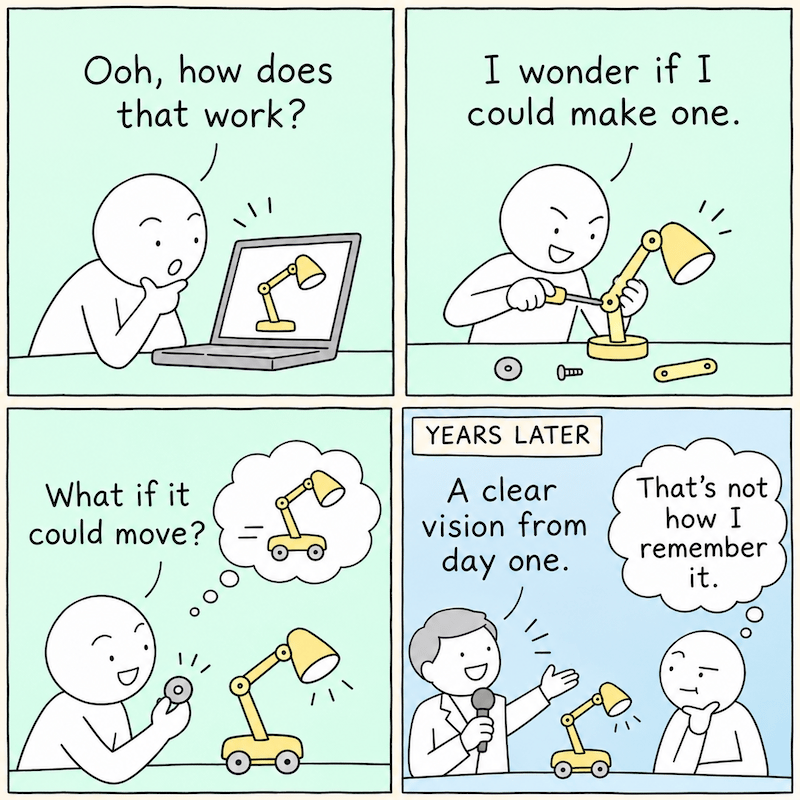
Tobi Lütke, who founded Shopify, tweeted: “People overestimate vision and underestimate what you can build when you follow your curiosity one step at a time for a decade+.”
Shopify started as an online snowboard shop. Tobi wanted to sell snowboards, the shop software available was bad, so he built his own. Other shops asked if they could use it. That’s the company. There was no master plan, just a next step that was interesting, repeated for a long time.
For example: the “where do you see yourself in five years” question makes a lot of people feel like they’re supposed to have an answer, and feel behind when they don’t. You don’t need one. You need the next thing you’re curious about: the tool you’d like to learn, the team whose work you keep reading about, the problem at work that annoys you enough that you’d fix it for free.
Take that step, see what it leads to, take the next one. The plan shows up afterwards, when you look back!
What did you think of the new format? I hope you learned a thing or five. If you enjoyed this:
Forward it to a friend, family member or colleague. It does truly make a difference.
If someone you know is on a job search, tell them to check out Resume Worded. It’ll make their job search a lot shorter.
Speak soon,

Rohan Mahtani
Founder at Coached & Resume Worded
Btw, I like reviews. They motivate me to keep the quality high. Like this one:

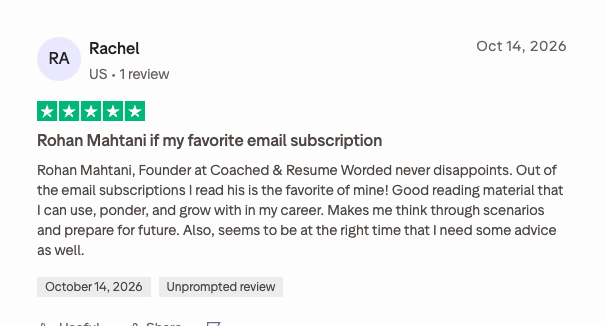
You can leave one here and I’ll feature it next time. I’d appreciate it. Thank you so much.
🤭 In all unseriousness
A few laughs to keep you smiling until next week
Don’t waste your time actually writing cover letters from scratch for each and every application. That doesn’t mean you should use ChatGPT/Claude though - they have tells which make it obvious to any hiring manager that it’s written by AI.
Use something like this AI cover letter tool that writes cover letters for you - it creates a story using your background that will fit what employers look for.
⚡ Try our career tools
How strong is your resume?
Find out your resume's score based on millions of real data points


Is your LinkedIn profile getting you rejected?
Our AI tool will fix yours in a couple of minutes.


If you’re new here, join at Coached.com to get the next one.
The answer to the quiz in the In all unseriousness question:
72. The pattern is that the bottom number equals the sum of the squares of the two top numbers:
2² + 2² = 4 + 4 = 8
5² + 5² = 25 + 25 = 50
6² + 6² = 36 + 36 = 72