One of the easiest ways to make a bad career decision is to follow perfectly good advice. Sounds backwards, but a lot of advice is only right for a certain person, at a certain time. In today’s Mentor’s Corner, I’ll show you how I figure out what’s worth listening to.
This is Coached Weekly, my career notes where I share the tiny % of ideas that actually work in real careers. It takes 5 minutes to read, but could speed up your career by years. I write this myself (no AI) and I read your replies. —Rohan Mahtani (LinkedIn)
Want to log in to Coached or see your personality assessments? Login.
The 20-second Career tactic
I've coached people for a decade. Here's one idea that moves the needle. I teach it in 20 seconds.
Stop making your work look easy
One easy way to get under-credited at work is to make difficult things look routine. You spend two days untangling bad data, chasing down missing context and fixing someone else's assumptions, then send: "Done! Here's the answer." To most, it’ll look like it was easy.
Instead, make the difficult bit a little visible: "This took some digging — the data lived in three systems that don't talk to each other. Here's the answer."
Now people value the output correctly and learn you handle messy problems. A win!

Mentor's Corner
Insights put together by me. One practical lesson a week that will make a measurable impact on your career, delivered right to you — for $0.
What to do when advice conflicts
Steve Jobs gave a famous speech at Stanford, where he told graduates that the only way to do great work is to love what you do, and that if you haven't found your passion yet, you should keep looking.
Interestingly, Mark Cuban says the opposite: don't follow your passion, follow your effort, because you'll end up loving whatever you get good at.
Who’s right?!
I think they're both right…about themselves. Jobs was obsessive; he only ever did well at things he was obsessed with, so of course that's his rule! Cuban is the kind of person who gets hooked on anything he starts winning at, so that's his.
A lot of advice is like this. Two smart people can tell you opposite things, and both can make perfect sense.
So how do you work out what actually applies to you?
🧭 Does this apply to me?
Take another common contradiction which contains good advice on each side: “say yes to everything” versus “say no to almost everything.” If your career has gone a bit quiet - you're not getting many opportunities, you're not trying new things, or you're early in your career - saying yes more is likely excellent advice.
If you already have ten things going on and can’t give any of them enough attention, the exact opposite is probably better.
When you hear advice or someone tells you to do something: don’t copy the rule, understand why it worked for that person. What problem were they solving? What was true about their situation?
Then ask the obvious question: is that true for me too? Don’t assume something that works for someone else is what you’ll enjoy too.
Side note: That’s also why I think finding out your wiring is super important. The better you understand how you naturally work, what gives you energy, how you make decisions, and what kinds of environments bring out your best, the easier it is to tell when someone else’s advice actually fits you and when it doesn’t.
To find out your wiring, take the ~3 minute personality assessment that maps a lot of this for you. It’s built on decades of psychology research, and goes much deeper than the usual four-letter personality stuff.
Take the test - it's freeOr enter coached.com/quiz in your browser.
🪨 Start with the boring answer
When I’m confused by a lot of different directions, I love to ask: what’s the boring, obvious answer here?
Take weight loss. You can spend months debating keto, fasting, meal timing, carbs, exercise routines, etc. But what's the boring answer? Eat less. Everyone already knows this. That's what makes it boring.
Which is why I find it pretty funny that Ozempic is arguably the biggest weight-loss breakthrough in decades - and all it does is make you…eat less. Billions in R&D, and the answer was the platitude the whole time. Ha.
I find this useful whenever I’m stuck. What’s the simplest answer here? Am I actually doing that? Why not?
Boring advice gets ignored because there’s a whole industry built on advice, and the obvious doesn’t sell :) The older I get, the more I realize the boring platitudes are often the best advice.
🧪 Can I just find out?
Here's a habit I've ingrained in myself. You're going to have a lot of people telling you what you should do: do this, try that, you have to be doing X.
Instead of taking their word for it or ignoring it, I step back and ask: can I just find out for myself? Can I run a small experiment and get my own answer?
Quick example: a lot of content creators say (no surprise) that creating content is the best thing you can do for your career. I could see it working for them, especially for job searching. I just didn't know if it was worth it for me. So I tested it: posted on LinkedIn consistently, grew a decent following, and paid attention to what it actually did for me. My answer: useful, but not useful enough to keep putting the same energy into it. So I'm less active there now and I don’t wonder about it anymore.
Get into the habit of testing things out in a small way first! If you’re thinking of switching careers, do a small paid gig at a reduced rate first. If you want to build a company, use AI to make a prototype first and try to market it.
Before making any big decision, ask: what could I do that would give me actual data?
🎙️ We trust confident people, even when they're wrong
The human brain has a pathetic flaw: we routinely mistake confidence for competence.
This is proven in the research too. There’s a 2013 study where people rated statements made with high confidence as far more credible, even when the speaker was demonstrably wrong and had no evidence to back it up.
When someone speaks with absolute conviction on a podcast or in a boardroom, your own instincts wobble. "They sound so sure. Maybe my read is completely backward."
Train yourself to develop an immune response to charismatic certainty. When someone speaks with zero nuance, try to mentally discount their certainty and look at the actual argument underneath. What do they actually know? What evidence do they have?
🤖 Use AI to argue the other side
AI can make almost any position sound convincing. Ask whether you should quit your job and it can make a great case for leaving. Ask why you should stay and it can make a great case for that too.
So I find it more useful as a sparring partner than an oracle. If I’m leaning one way, I’ll ask it to make a case for the opposite, point out what I might be assuming, and tell me what information would change the answer. It helps me stay grounded and make up my own mind!
I hope you learned a thing or three. If you enjoyed this:
Forward it to a friend, family member or colleague. It does truly make a difference.
If someone you know is on a job search, tell them to check out Resume Worded. It’ll make their job search a lot shorter.
Speak soon,

Rohan Mahtani
Founder at Coached & Resume Worded
Btw, I like reviews. They motivate me to keep the quality high. Like this one:
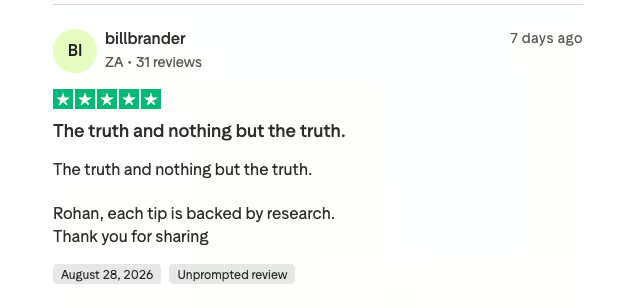
Thank you Bill!
You can leave one here. I’d appreciate it. Thank you so much.
🤭 In all unseriousness
A few laughs to keep you smiling until next week
Don’t waste your time actually writing cover letters from scratch for each and every application. That doesn’t mean you should use ChatGPT/Claude though - they have tells which make it obvious to any hiring manager that it’s written by AI.
Use something like this AI cover letter tool that writes cover letters for you - it creates a story using your background that will fit what employers look for.
⚡ Try our career tools
How strong is your resume?
Find out your resume's score based on millions of real data points


Is your LinkedIn profile getting you rejected?
Our AI tool will fix yours in a couple of minutes.


If you’re new here, join at Coached.com to get the next one.