You probably won’t get through a good career without regularly doing things that make you nervous. So I think learning how to handle that feeling is a much more useful skill than trying to outgrow it. Today’s Mentor’s Corner is about what’s helped me personally.
If you haven’t tried this yet, you really should: Our new personality assessment takes ~3 minutes, but gives you a surprisingly detailed read on how you think, work and relate to other people. It’s built on decades of psychology research. This kind of deep personality insight normally costs $50-100, but this is free (I’m covering the costs).
A new thing we added is that you can add a partner, friend or coworker and see why you click. I’ve done it with 20 people already - it’s awesome.
This is Coached Weekly, my career notes where I share the tiny % of ideas that actually work in real careers. It takes 5 minutes to read, but could speed up your career by years. I write this myself (no AI) and I read your replies. —Rohan Mahtani (LinkedIn)
Want to log in to Coached or see your personality assessments? Login.
The 20-second Career tactic
I've coached people for a decade. Here's one idea that moves the needle. I teach it in 20 seconds.
Disagree with a question, not a statement
When someone senior proposes something flawed, "I disagree, that won't work" forces them to defend it. Now it's their ego vs. your point, and their ego wins. Instead, ask the question that leads them to the flaw: "How are we thinking about this handling the Q4 volume spike?"
If the flaw is real, they'll hit it themselves and an idea someone talks themselves out of dies, with no loser in the room. If there's actually a good answer, you just look thorough instead of wrong.

Mentor's Corner
Insights put together by me. One practical lesson a week that will make a measurable impact on your career, delivered right to you — for $0.
Why you never stop being nervous
I get nervous more than you'd think. I've sent about 350 of these newsletters and I often still get a knot in my stomach before each one goes out. I feel the same right before a big presentation, or a meeting with someone "important".
I always assumed I'd grow out of it when I got older. But it obviously hasn't happened, and it doesn’t seem to happen for anyone. Adele has said she's thrown up before shows, and once escaped through a fire exit in Amsterdam rather than go on stage. She has thousands of performances behind her. If that much practice didn't cure it, a few hundred presentations wasn't going to do it for me!
So I started trying to understand (and use!) my nerves instead. Here's what has worked for me and might for you too…that isn’t just ‘PrAcTiCe MoRe!’ (duh!).
🧭 Nerves measure stakes, not skill
Think about when you actually get nervous. Not when you order a coffee: you know exactly how that goes, and you don't care much anyway. But asking for a raise, going on a first date, presenting to people you respect... now the knot shows up. Three things are true in those moments: you care about the result, you can't be sure of the result, and you're on ground that's at least a little new and unfamiliar.
Notice that “skill”, or how good at the thing you are, isn't on the list. That's also why, interestingly, practice doesn't always cure nerves.
Practice makes you better at the thing, but it doesn't make you care less, and it can't make the outcome certain. Adele on her thousandth show still wants tonight's crowd to love her, and still doesn't know if they will. So the anxiety continues.
🍀 Which means nerves are, weirdly, good news
If you're nervous, you're by definition doing something new (and outside your comfort zone) where you care about an uncertain result. How often does that describe your week? For most people, rarely. You can arrange an entire life so it never happens: stick to what you know, want things only mildly. People who live that way will tell you they never get nervous anymore, and they're right, but not for a reason you'd envy.
Researchers who ask the elderly about their regrets often find the same pattern: the regrets are overwhelmingly things they didn't do. The chance not taken, the person not asked. Nerves show up right before the moments that matter, so if you treat them as a stop sign, you stop exactly where you’d regret it later.
“OK, Rohan…I get that nerves are supposed to be good, but I hate them - I always screw up.” To that I’d say that part is fixable…
🫥 Nobody can see it
We assume our inner state is visible to everyone. It mostly isn't. Nobody can see your heart rate or your stomach. In studies of public speakers, people rated their own nervousness as obvious while audiences barely noticed anything. Psychologists call this the illusion of transparency.
When researchers simply explained this illusion to speakers beforehand, their speeches got measurably better. Much of the spiral is worrying about how nervous you look. Once you know you look roughly fine, you mostly are.
🐢 The one thing people can see is speed
Nervous people talk fast, because silence feels dangerous. It's the single biggest tell.
When I did standup comedy, I internalized this. When I spoke slower, the jokes had time to land, the pauses let the audience lean in, and I ultimately did much better - even on nights I was sh*tting bricks. I think this applies outside of standup too - on things I’m nervous about, I intentionally speak slowly. Talking at half your natural pace feels ridiculous from the inside and sounds like total control from the outside.
⚡ Don't try to calm down
Calm and nervous are opposite physical states. Calm is low adrenaline and a slow heart; nervous is the reverse. You can't talk your body across that whole distance in the two minutes before a meeting.
But there's a state right next door: excitement. Physically it's identical to nervousness, racing heart and all. The only difference is the label. A Harvard researcher, Alison Wood Brooks, had people say "I am excited" out loud before public speaking and math tests, and they consistently outperformed people who'd said "I am calm." Your body won't believe it's calm, but it will happily believe it's excited.
And whatever nervousness the relabel doesn't remove, I've learned to just welcome. Nerves mean you're doing something new that matters to you. In other words, you're growing. So these days when the knot shows up, I pause, smile, and remind myself I'm lucky to have something worth being nervous about. It sounds a bit silly, but it works.
🎬 Nail the opening
Nerves peak before you start, then fade quickly once you're going. That suggests some cheap tricks. In a meeting, say something in the first few minutes, because the longer you stay silent the harder speaking gets.
Before a presentation, script your first minute word for word, since that's the only part your nerves will actually touch. When you’re meeting a bunch of new people, prepare a great intro — use this AI tool which will write you an elevator pitch that you can use in every conversation going forward — so that first minute goes smoothly.
One tip - in many rooms, you can simply call your nervousness out loud - e.g. "wow I didn’t think I’d be this nervous." It disarms people.
📏 Nerves as a gauge
Nerves don't go away, but what triggers them moves as you go. The first time you led a meeting, you probably were a bundle of nerves. After a few, it's fine, and something bigger has taken its place. Your nerves always sit at the edge of what you've done so far.
That makes them a strangely useful way to check on yourself. Ask whether you're nervous about bigger things than you were three years ago. If you are, you're growing. If the same things still scare you, or if nothing does anymore because everything you do is something you've done before, that usually means you're slightly more settled into things you already know how to do. Which isn’t a bad thing obviously, but a useful signal to measure one part of your career.
Either way, go get those nerves :)
I hope you learned a thing or three. If you enjoyed this:
Forward it to a friend, family member or colleague. It does truly make a difference.
If someone you know is on a job search, tell them to check out Resume Worded. It’ll make their job search a lot shorter.
Speak soon,

Rohan Mahtani
Founder at Coached & Resume Worded
Btw, I like reviews. They motivate me to keep the quality high. Like this one:
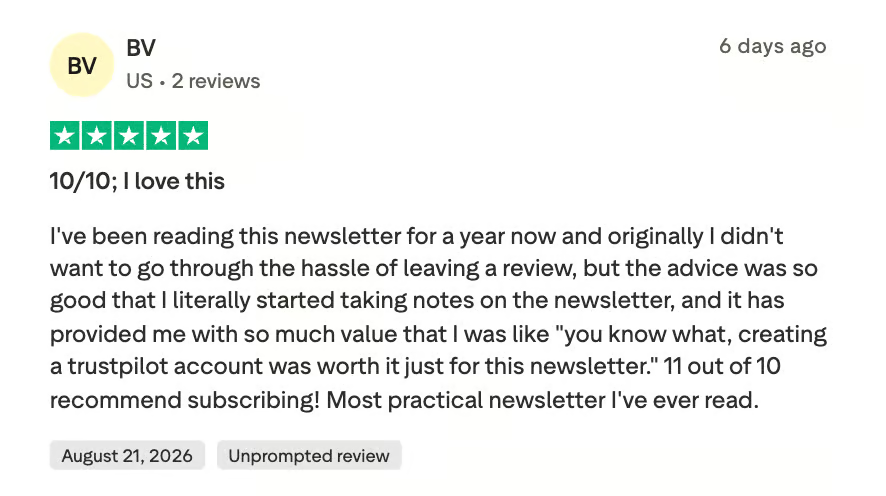
I live for reviews like these! Thanks BV!
You can leave one here. I’d appreciate it. Thank you so much.
🤭 In all unseriousness
A few laughs to keep you smiling until next week
Don’t waste your time actually writing cover letters from scratch for each and every application. That doesn’t mean you should use ChatGPT/Claude though - they have tells which make it obvious to any hiring manager that it’s written by AI.
Use something like this AI cover letter tool that writes cover letters for you - it creates a story using your background that will fit what employers look for.
⚡ Try our career tools
How strong is your resume?
Find out your resume's score based on millions of real data points


Is your LinkedIn profile getting you rejected?
Our AI tool will fix yours in a couple of minutes.


If you’re new here, join at Coached.com to get the next one.