Presentations are one of the few moments in your career when all eyes are on you — and most people waste them. This week's Mentor's Corner is a no-BS guide to presenting well, with some stuff I've picked up from a decade of presenting in pretty much every room you can think of.
This is Coached Weekly, my career notes where I share the tiny % of ideas that actually work in real careers. It takes 5 minutes to read, but could speed up your career by years. I write this myself (no AI) and I read your replies. —Rohan Mahtani (LinkedIn)
Want to log in to Coached or see your personality assessments? Login.
The 20-second Career tactic
I've coached people for a decade. Here's one idea that moves the needle. I teach it in 20 seconds.
Ask "what would you do?" before giving your answer
Good advice for managers:
When someone on your team comes to you with a problem, resist the urge to solve it immediately. Ask them what they'd do first. Half the time their instinct is right and they just needed permission. The other half, you'll give better advice because you've heard their thinking + context first.
Heads up:
Working on your resume or know someone who is?
Don’t forget that you can get a free resume review here.
It’ll speed up your job search (or your friend’s).

Mentor's Corner
Insights put together by me. One practical lesson a week that will make a measurable impact on your career, delivered right to you — for $0.
What I've learned about presentations (from every room I've been in)
Today's essay is about something most people underinvest in: presentations.
It makes sense why. Depending on what you do, you might only present something new every month or two. It's not a daily skill. But that's exactly what makes it so high-stakes — when you do present, all eyes are on you. It's usually a deliverable someone important or senior is watching. And people form lasting opinions from it.
Steve Jobs understood this more than anyone. He presented Apple's new products once a year. He knew that even though it was just once a year, it was how the world judged Apple. So he mastered them. It’s why people still remember his launches from 20 years ago. Meanwhile, Google and Samsung have shipped equally impressive products, and no one can recall any!
I've given presentations in pretty much every room you can think of. I started my career in corporate where I’d present to C-suite each month. Then, through running Resume Worded, I’ve done investor pitches, sales demos, team meetings among others. I've also been on the other side — people pitching me. And I’ve seen how bad people are at this stuff.
I've picked up a few things.
🎯 Get the story right first
Before anything else: what's a presentation actually for? It's to communicate a story. That story might be a problem you've found, an idea you're proposing, a product you're launching. But it's always a story.
If you want to create a strong presentation, get clear on what that story is. Ask yourself: what are the 1-3 things I really want my audience to take away?
That single decision feeds everything: what you open with, what you leave out, and what you repeat.
Most people do it backwards. They start with the slides and then figure out how to order things later.
Say you're pitching to investors. Your story is probably something like "there's X massive problem, we've figured out how to solve it, and we're the team to do it." That’s your anchor - that guides what to start with (the big problem).
If you jump into slides without figuring that out, you may make the mistake of starting with "Our Team" because that’s easiest to fill out. But now your audience is looking at headshots before they have any reason to care who these people are.
Start with the story. Build slides around it.
🤖 The AI trap
You can generate a full slide deck with AI in about 30 seconds now. And the output *looks* good and professional. But is it actually?
The problem is that it makes it very easy to skip the step we just talked about. You type "make me a presentation about Q3 results" and you get 15 polished slides that say little and have no narrative. The design is so good that it tricks you into thinking the presentation is done. It's not. It's just pretty slop.
It's the same thing with resumes — people obsess over design when the content is what actually matters. (This is why Resume Worded works so well - it helps you get your content right first, get a resume review here.)
AI is great for presentations. Use it. But use it after you've figured out your story, not instead of figuring out your story. Get your narrative and takeaways clear first, then use AI to build slides around them, sharpen your headlines, draft speaker notes.
📰 Headlines, not titles
Once you have your story, there's a hack I tell everyone that'll make every slide stronger: the title of each slide should be the takeaway, not a label.
Most people title their slides like chapters in a textbook. "Our Team." "The Problem." "How It Works." These tell the audience what category of information is coming, but nothing about what you actually want them to think.
Turn them into headlines:
"The Problem" → "10m+ jobseekers lack direction."
"How It Works" → "We help you write your best resume, with AI."
"Our Team" → "We've built three tech startups before."
The test: If someone flipped through your deck without hearing you speak, would the slide titles alone tell them your story? If not, rewrite them until they do.
📦 Building the deck
You've got your story + takeaways. Now your job is to make sure it sticks.
One effective way to do that is to repeat your key takeaways at least 3x. Open with your main takeaway, bring it back in the middle, and then close with it.
Say I’m doing sales for Apple and I’m trying to sell iPads to a design agency. I might decide my core story I want to get across is “iPads will increase their team’s efficiency by 50%”. In my presentation, I’d open with it, come back to it midway through when I’m talking features, then close with it so they remember that key idea.
My formula: A successful presentation = Does your audience remember what you want them to?
On that note — keep each slide to one idea. The moment a slide has two things going on, your audience is reading ahead instead of listening to you. The slide is there to support what you're saying, not replace it.
For everything else, use the "so what?" test. Go through every slide and ask: does this clearly support one of my 1-3 takeaways? If not, cut it. Most presentations are twice as long as they need to be, and most audiences lose focus after about 20 minutes.
⚡ Delivery
You can have the best narrative, the cleanest slides, and a perfectly rehearsed script. None of it matters if you deliver it like you're reading a terms of service.
Tony Robbins literally jumps on a trampoline backstage before he goes on. You don't need to do that. But you do need to be aware of your energy. Are you speaking in a monotone? Are you hunched over? Are you looking at the screen instead of the audience?
The other thing: use your voice to signal what matters. Slow down before your key takeaway. Pause after it. Let it land. If everything is delivered at the same pace, the audience treats everything as equally important, which means nothing stands out.
🌍 The presentation you give most often
The most common presentation you give isn't in a boardroom. It's when someone asks "so, what do you do?" at a dinner, a networking event, or an interview. And most people are terrible at it — they either ramble for two minutes or give a job title and stop.
Same principles apply. Know your story. Have a version that's one sentence and a version that's thirty seconds. Lead with what's interesting, not what's technically accurate.
If you went to a career strategist, this is actually the first thing they'd work on with you — how to introduce yourself without sounding cringe and self-promotional. But good strategists are expensive.
So our research lab made a free tool that does it for you.
It's called the Coached Elevator Pitch. It tells you what to lead with + how to sound impressive to everyone you meet.
Enjoy!
Hopefully that’s a piece of advice you haven’t heard before. If you enjoyed this:
Forward it to a friend, family member or colleague. It does truly make a difference.
If someone you know is on a job search, tell them to check out Resume Worded. It’ll make their job search a lot shorter.
Speak soon,

Rohan Mahtani
Founder at Coached & Resume Worded
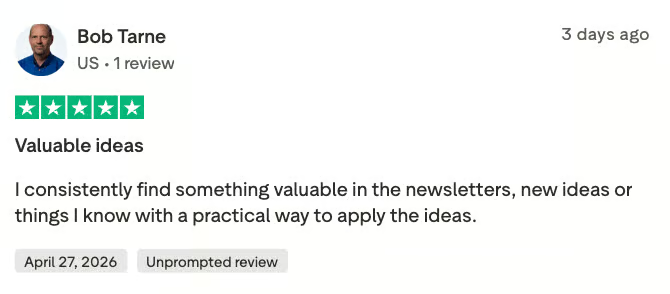
Btw, I like reviews. They motivate me to keep the quality high. Like this one:
Thank you! I made today’s one extra practical, hope you take something away
You can leave one here. I’d appreciate it. Thank you so much.
🤭 In all unseriousness
A few laughs to keep you smiling until next week
🤣 Important: it’s 2026. You shouldn’t be writing your cover letter from scratch anymore. This AI cover letter tool writes cover letters from scratch. And no one can tell it’s AI (unlike ChatGPT).
Try it just once for a job you actually want — see how good it is for yourself. Takes two seconds to get a great cover letter (instead of the usual 6 hours!).
⚡ Try our career tools
How strong is your resume?
Find out your resume's score based on millions of real data points


Is your LinkedIn profile getting you rejected?
Our AI tool will fix yours in a couple of minutes.


If you’re working on your resume, get your resume score here. The tool will write you hiring manager-approved bullet points (unlike ChatGPT).
If you’re new here, join at Coached.com to get the next one.