
There's a reason some people improve fast and others plateau for years. This week's Mentor's Corner is about the difference: feedback.
This is Coached Weekly, my career notes where I share the tiny % of ideas that actually work in real careers. It takes 5 minutes to read, but could speed up your career by years. I write this myself (no AI) and I read your replies. —Rohan Mahtani (LinkedIn)
Want to log in to Coached or see your personality assessments? Login here.
The 20-second Career tactic
I've coached people for a decade. Here's one idea that moves the needle. I teach it in 20 seconds.
How I think about nervousness
I love when I feel nervous - which I know sounds a bit weird. Why? Because I’ve realized it means I’m doing something I genuinely care about, or something outside my comfort zone (a good place to be!).
Most people rarely get to feel genuinely nervous. They don't get to work on something they care deeply about, or something that's truly new to them. (This might sound a bit woo woo, but...) it’s such a pure emotion and you’re lucky enough to feel it!
Heads up:
Working on your resume or know someone who is?
Don’t forget that you can get a free resume review here.
It’ll speed up your job search (or your friend’s).

Mentor's Corner
Insights put together by me. One practical lesson a week that will make a measurable impact on your career, delivered right to you — for $0.
The art of seeking out tough feedback (and why you need to master it)
When you watch guys like Kevin Hart and Chris Rock do stand-up, it all looks so effortless and natural.
The timing of their jokes. Their facial expressions. The stories they tell. It feels like they're just naturally funny.
But what you see on stage isn’t natural at all. It’s a performance that’s been honed for weeks, months, or even years, by testing out material at small comedy clubs unannounced.
Kevin Hart performs at Madison Square Garden, but in the year leading up to it, he's workshopping every joke in front of 20 people at a tiny venue.
New joke gets a laugh? Keep it.
Bombs? Scrap it. Try a different angle. Test again.
So, the key ingredient for a legendary comedy routine isn’t “humor” necessarily.
It’s feedback. Comedians are masters at getting feedback — and using it.
Careers work the same way. There's a gap between how you think you come across and how you actually come across, and most of your blind spots live in that gap. The way to close it is feedback — but most don’t seek it. It's uncomfortable, and when they do ask, they ask badly.
So let's fix that.
🦁 Don't bite
When someone gives you feedback, your instinct will be to defend yourself. "But I did that because..." or "Well actually, the context was..."
Don't. Say "I hear you" or "thanks, that's helpful." Pause for a minute (or longer). Evaluate if they’re right later.
I’m sure you know those people who get defensive at the tiniest suggestion. You never give them feedback again. It's not worth the hassle. Don't be that person. Show people you're coachable, and they'll keep giving you the thing you need most.
🎯 Why "any feedback?" doesn't work
Most people do ask for feedback. They just ask badly.
"Any feedback on my presentation?" will almost always get you "Yeah, it was great!" People are polite. Vague questions make it easy to dodge.
If you want useful feedback, you have to make it specific and make it safe. A few ways to do this:
Ask about a specific moment. Instead of "feedback on my presentation?", try "Did my answer about pricing sound defensive? Feel free to be blunt." When you pinpoint a moment and invite honesty, people give you something useful.
Ask for a 0-10 score. When you finish a project or task, ask for a score between 0 and 10. Nobody says 10, so you follow up: "What would've made it closer to a 10?" Now they have to give you something specific. (h/t Adam Grant for this one.)
Give them permission to be honest. Most people hold back because they're worried about how you'll react. So tell them directly:
"Hey, I've been trying to get better at X — you've seen me do it enough, what am I missing?"
"I genuinely won't be weird about it. I'm asking because I trust your read on things."
My point: make it easy and safe for the other person to be honest. Most people won't volunteer tough feedback. But they'll give it if you ask the right way.
🧬 Not just at work
When people hear "feedback" they automatically think about work.
But I’m guessing you're trying to improve at things outside work too — maybe your health, your attitude towards life, how you handle stress, whether you're playing it too safe. Feedback’s how you get better at those too.
Where do you get that feedback from? Your friends.
Same rules: be specific, make it safe. Ask a close friend for feedback on something you’re trying to get better at. It’s uncomfortable to ask (…but that’s how you grow).
🤖 AI is a cheat code here
The hardest part about feedback is the awkwardness of asking for it. AI removes that. Paste a presentation or email into Claude or ChatGPT and ask "where is this weakest?" or "what would a skeptical audience push back on?" and you'll get a more direct answer than most people would give you.
One thing to watch out for: you’ve probably experienced this, but AI is way too agreeable by default. Ask "is this good?" and it'll say yes. You have to actively tell it to be critical, or you'll just get reassurance.
If you want that kind of honest feedback on your career, here’s something to try: Career Deep Read. It’s very effective.
You just give it your LinkedIn URL (that’s it), and in ~2 seconds, it decodes your career and tells you what to look out for.
It doesn't sugarcoat things, which is kind of the whole point of this essay. Worth trying: coached.com/deep-read
🙅🏻♂️ Not all feedback is equal
All of the above — human feedback or AI feedback — comes with the same caveat: you still need judgment about what to listen to.
If you wanted to be a stand-up comedian but asked someone who's sensitive to your style of jokes, they'd probably say they hate it. That feedback isn't useful — it's not coming from your target audience. Humor's subjective.
The point is, take in everything you hear as a data point, not a verdict. Not all feedback is good feedback. But the people who seek it out — even the bad stuff — are always the ones who improve the fastest.
Hopefully that’s a piece of advice you haven’t heard before. If you enjoyed this:
Forward it to a friend, family member or colleague. It does truly make a difference.
If someone you know is on a job search, tell them to check out Resume Worded. It’ll make their job search a lot shorter.
Speak soon,

Rohan Mahtani
Founder at Coached & Resume Worded
Btw, I like reviews. They motivate me to keep the quality high. Like this one:
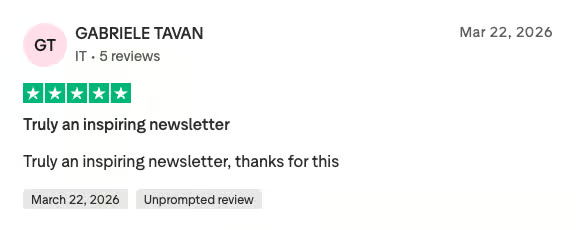
Grazie Gabriele!
You can leave one here. I’d appreciate it. Thank you so much.
🤭 In all unseriousness
A few laughs to keep you smiling until next week
⚡ Try our career tools
How strong is your resume?
Find out your resume's score based on millions of real data points


Is your LinkedIn profile getting you rejected?
Our AI tool will fix yours in a couple of minutes.


If you’re new here, join at Coached.com to get the next one.