Sponsored by

Opportunities don't go to the most qualified person. They go to whoever comes to mind first. The intro, the referral, the "I thought of you for this" — that all goes to whoever's most memorable. Today's Mentor’s Corner essay is about how to be that person, and it's easier than you think.
This is Coached Weekly, my career notes where I share the tiny % of ideas that actually work in real careers. It takes 5 minutes to read, but could speed up your career by years. I write this myself and I read your replies. —Rohan Mahtani (LinkedIn)
Want to log in to Coached or see your personality assessments? Login here.
The 20-second Career tactic
I've coached people for a decade. Here's one idea that moves the needle. I teach it in 20 seconds.
Connect the dots backward
Have you ever stopped to look back at your career? There's a Steve Jobs quote I think about a lot: "You can’t connect the dots looking forward, only looking backwards."
What he's really saying is that your career choices look random while you're making them. But when you look back, you start seeing weirdly consistent patterns — the kinds of roles you're drawn to, the things you enjoy, or the root of your motivations. That’s your wiring.
What’s fascinating to me is the answer to a lot of our career questions — like the all-time classic “what will make me happy?!” — is literally encoded in your wiring already. But most of us never pause to decode it. But I think you should!
If you want to actually decode your wiring, we built something for this: Career Deep Read. I sent this out last week - people love it! You just paste your LinkedIn profile, it analyzes it, and tries to find your patterns and wiring. It’s based on a ton of research.
Get your Career Deep Read → (takes 2 seconds)
If you already tried it, you can log in and re-read yours. And ask ANY question based on your profile (a new feature!).

Sponsor Spotlight
Roku's Ad Platform has been awesome enough to support today's email. Check 'em out!
How Jennifer Aniston’s LolaVie brand grew sales 40% with CTV ads
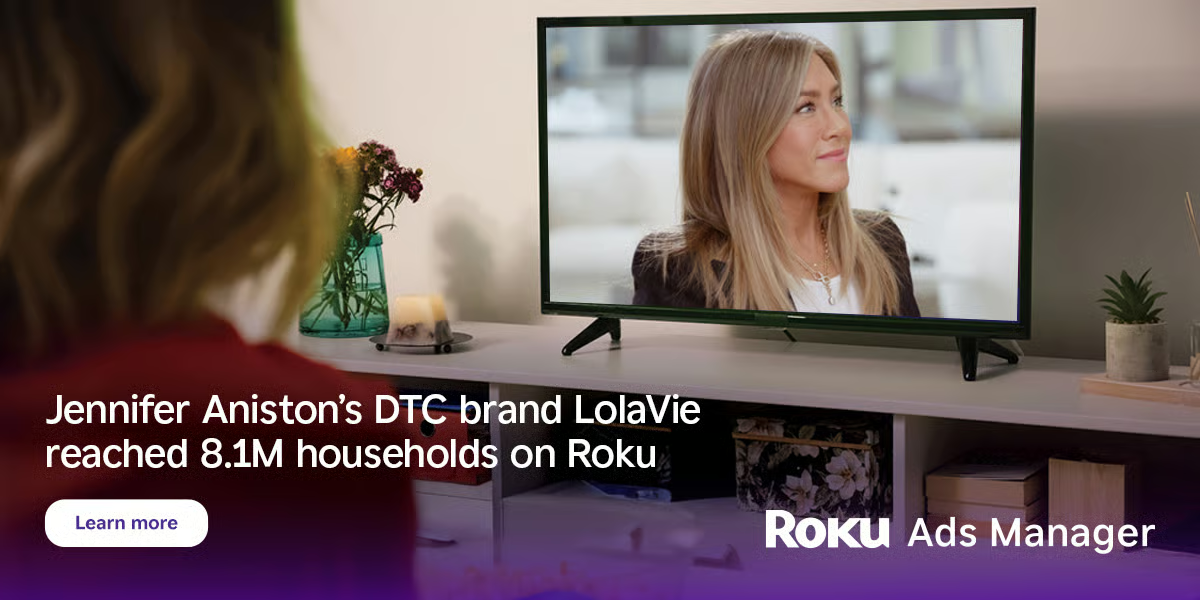
The DTC beauty category is crowded. To break through, Jennifer Aniston’s brand LolaVie, worked with Roku Ads Manager to easily set up, test, and optimize CTV ad creatives. The campaign helped drive a big lift in sales and customer growth, helping LolaVie break through in the crowded beauty category.
Mentor's Corner
Insights put together by me. One practical lesson a week that will make a measurable impact on your career, delivered right to you — for $0.
The 10% trick to standing out at work
Don't ask me why, but a while back I watched a mini-documentary about one of the world's most expensive hobbies:
Keeping koi.
The video-maker visited a collector in Dubai with a "casual" koi collection worth over 10 million dollars. The most valuable fish? Around $250k.
How can a fish be worth more than a mortgage?
The documentary explained:
The difference between a valuable koi and a worthless one isn't a big thing like size or age, but small variations in their scale patterns. If the pattern is even slightly different — maybe just 10% — from a normal koi, the value skyrockets.
In a weird way, there's something koi-like in careers too.
Often, we don’t need to be miles better to stand out. Sometimes, being just 10% different is enough to have a “wow” factor.
Take, for instance...
🦁 3 special sentences
The following is a real cold email I saw online that I loved:
==================
Hi Giuseppe,
I see you’re an active gardener. I just planted some lantanas at my home in Santa Clara, and they aren’t looking too hot. Any advice?
But I’m also a statistics Master’s student at Stanford looking to break into the quantitative trading world. Any chance you could help?
Thanks a ton. (source)
The second paragraph is just a normal cold email. The first paragraph (lantanas) is the 10% difference that makes it stand out.
And this isn't just a cold email thing. A street of identical houses will sell for the same price, but the one with a treehouse or a funky mailbox sells for more. You meet a hundred people at a networking event, but you remember the one who told that funny joke. The server who does the same job but with a smile gets way more tips.
Small differences are a big deal everywhere.
🧘 The nudist buddhist rule
So why do small differences work so well?
People similar to us make us feel safe. People who are totally different make us uncomfortable. Putting yourself between those two extremes is what makes you compelling.
You're conventional enough to tick the expectations box — meeting your audience's desire for conformity and professionalism. But with a few small differences to make you novel and exciting.
A nudist OR a buddhist is compelling, but not a nudist buddhist. (Although, tbh, I think being a nudist on its own is too weird anyway.)
In other words: Instead of being 100% conventional, be 90% conventional with 10% novelty.
😶 But most people never do this.
Professional environments actively train the personality out of you. From your first job, you learn to match the tone, use the same templates, write emails that sound like everyone else's emails.
You learn that fitting in is safe. And it is safe. But safe is also invisible.
You don't need to be wildly different. You just need to be slightly more yourself than everyone else is willing to be.
Here's where to start:
🗣️ How you show up in conversations
The email strategy I shared earlier is gold (use it). But you can apply the same kinda thing when you talk to people.
For example, in small talk. Why is it boring? Because you already know what they're going to ask you. So throw in some curveballs. Someone's told you they're an accountant. Instead of weather chat or the boring follow up "what types of companies do you work for," try: "Huh. What's the most surprising thing you've learned as an accountant?"
One different question and the conversation goes somewhere nobody expected.
Introducing yourself is another one. Most people introduce themselves exactly the same way ("Hi, I'm [name], I work at [company] as a [title]"). It’s boring, forgettable and makes conversations with new people tough.
❌ Bad: "I work in data science in New York."
✅ Good (10% different): "I'm originally from a tiny town in Ohio, moved to New York about five years ago on a whim, now I do data science at an edtech company. Still not used to paying $7 for a coffee but I love it here."
The second one gives people three things to grab onto.
⚡ Your 10% is already there
Here's what the cold email and my other examples all have in common: none of them are about performing. The Stanford student didn't pretend to like gardening. He actually liked gardening. He just let that into a professional context where everyone else would've left it out.
That's the gist. The 10% that makes you memorable isn't something you need to invent. It's something you have but filter out because work is supposed to be "professional."
Some ideas to stimulate your thinking - I call these pattern interrupts.
Instead of labelling a section of an email/report "The Problem," call it "The Murky Bit" or "Where Things Get Interesting." Same information, but it’s a pattern interrupt and gets engagement.
Start a meeting with a short story instead of diving straight into the agenda (like I tried to do with the koi story in this write-up!).
Bring a physical prop to a presentation. Use a whiteboard instead of just slides. Throw a meme into a deck when the moment's right.
Someone who works in the aquarium industry signs off their emails with "Best Fishes." (interesting email signatures are underrated!)
Handwrite a letter. When was the last time you received one? Probably never. So next time you want to thank someone — a mentor, a client, a colleague who helped you out — try writing one. A handwritten note in 2026 says more than any email ever could.
I throw jokes and memes into every essay I write. My "in all unseriousness" section exists at the end because I think career advice doesn't need to be dry to be useful. And I love standup comedy. That's my 10%. It won't be yours — and it shouldn't be (humor is tricky and should only be used in the right rooms!).
The question isn't "what quirky thing can I add?" It's "what am I already filtering out?"
Hopefully that’s a piece of advice you haven’t heard before. If you enjoyed this:
Forward it to a friend, family member or colleague. It does truly make a difference.
If someone you know is on a job search, tell them to check out Resume Worded. It’ll make their job search a lot shorter.
Speak soon,

Rohan Mahtani
Founder at Coached & Resume Worded
Btw, I like reviews. They motivate me to keep the quality high. Like this one:
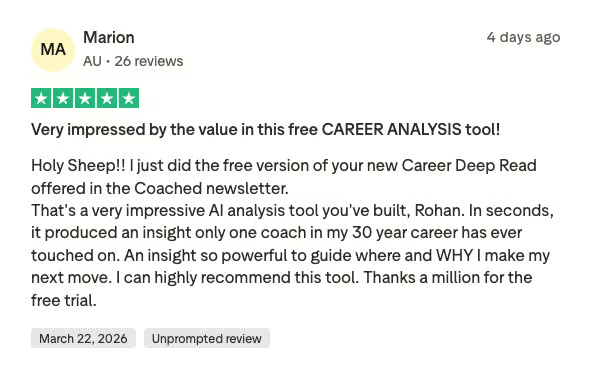
go try it people @ coached.com/deep-read
You can leave one here. I’d appreciate it. Thank you so much.
🤭 In all unseriousness
A few laughs to keep you smiling until next week
⚡ Try our career tools
How strong is your resume?
Find out your resume's score based on millions of real data points


Is your LinkedIn profile getting you rejected?
Our AI tool will fix yours in a couple of minutes.


If you’re new here, join at Coached.com to get the next one.