In partnership with

If you had a different group of friends, would you still want the same job, home or lifestyle? I think we underestimate how much the people around us shape the things we want. Today’s Mentor’s Corner gets into some psychology I’ve been reading about that helps explain why + how to save years chasing the wrong path.
This is Coached Weekly, my career notes where I share the tiny % of ideas that work in real careers. It takes 5 minutes to read, but could speed up your career by years. I write this myself (no AI) and I read your replies. —Rohan Mahtani (LinkedIn)
Want to log in to Coached or see your personality assessments? Login.
The 20-second Career tactic
I've coached people for a decade. Here's one idea that moves the needle. I teach it in 20 seconds.
Give people something to ask you about
Here's a good rule when meeting someone new: don't just tell them what you do. Give them something interesting to ask you about.
Most people introduce themselves like they're reading their CV. Their job, company, maybe where they went to university. It's technically useful information, but not much of a conversation starter.
❌ Bad: "I'm a product manager at a fintech company. Before that I worked in consulting."
✅ Better: "I started out in consulting, but got tired of making recommendations and never seeing what happened to them. So I switched to building products instead."
The second version gives someone something to be curious about. Why did you switch? Was consulting really that bad? What are you building now?
Just one interesting detail about how you got where you are can make you much easier to connect with -- which is the key to building professional relationships!
And this applies online too. Think of your LinkedIn profile as an introduction to hundreds of people you haven't met yet. If all it tells them is where you've worked, you're making the same boring introduction, just in writing.
But what should you actually say instead?!
Get your Personal Brand Strategy →
It’s free and you’ll get a strategy for what to be known for and what to talk about. It's the kind of thing CEOs and celebrities pay brand strategists thousands to help them figure out.

Spotlight
B2B support leaders who made AI work
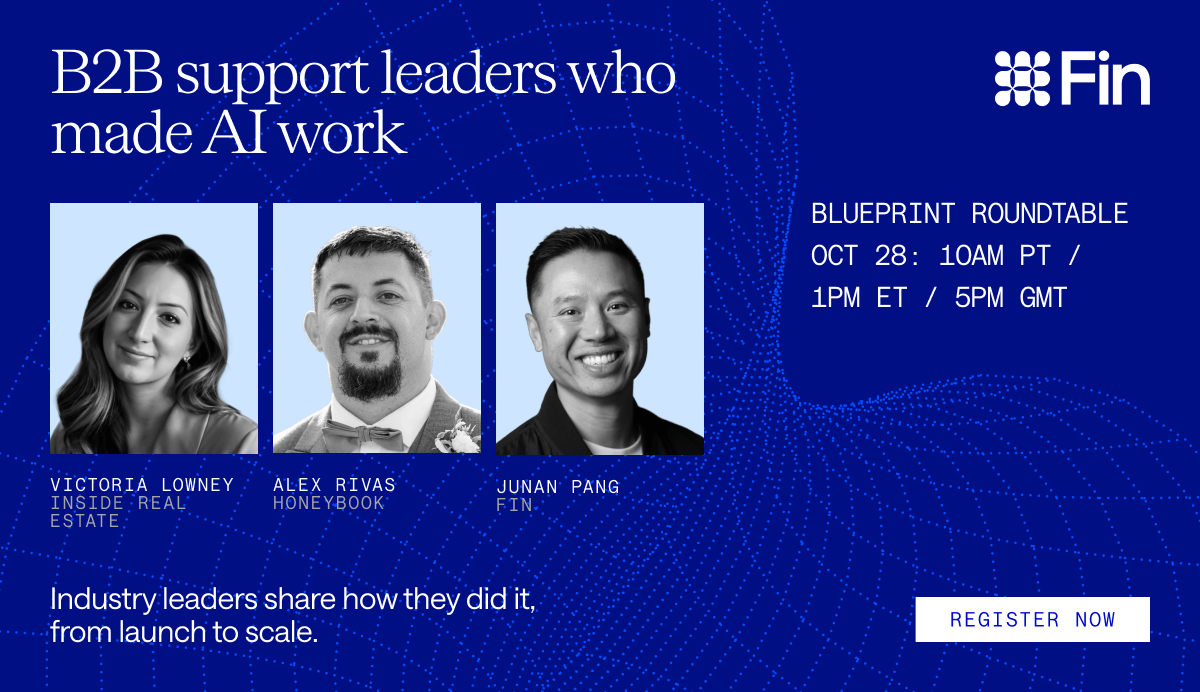
AI agents are reshaping B2B support, and a few leaders are already ahead. Join Victoria Lowney of Inside Real Estate and Alex Rivas of HoneyBook as they share how they launched, scaled, and what's next. Hear how they built the business case, connected AI to data and systems, and reshaped team roles. Live Q&A. Register now to save your spot and get the recording.
Mentor's Corner
Insights put together by me. One practical lesson a week that will make a measurable impact on your career, delivered right to you — for $0.
How I nearly chose the wrong career
When I was in college, all my friends wanted to be the same thing:
Management consultants.
It might sound boring, but everyone ambitious I knew dreamed of working at McKinsey, the most "prestigious" consulting firm at the time.
So guess what I wanted to do with my life?
Yup.
I wanted to be a management consultant at McKinsey too.
The funny / scary thing? I never once asked myself whether I'd enjoy it. I just wanted to get in. I did months of case prep, practice interviews, got through 5 interviews.
Then, I screwed up the final one and got rejected.
At the time, naïve 21-year-old Rohan was devastated. But it was the best thing that ever happened to me.
Because I ended up in tech, which I'd been treating as my backup plan, and it suited me about a hundred times better.
What's strange, looking back, is how certain I'd been. No one pressured me - my friends/family never told me "you should do consulting," nor was it a childhood dream. I just saw how highly people spoke of the job, and I started wanting it too. It felt like my own ambition.
I was 21, so fine, I was young and impressionable. But I’m not sure age has much to do with it. I don’t think enough people, at any age, stop to ask where their goals came from.
🧠 We learn what to want
There’s a French thinker, René Girard, who had a theory about exactly this. He called it mimetic desire.
His theory: We don’t actually know what we want. So we work it out by watching the people around us. We see what they’re chasing, and we start chasing it too.
My favorite evidence for this is a study of lottery winners in the Netherlands. When someone won, their next-door neighbors started spending more on cars. The neighbors hadn't won anything! But someone else’s wants/desires made them want things too.
It’s also why every few years everyone suddenly wants the same thing. The Labubu toys went viral last year; it’s not like anyone’s ever woken up randomly and independently decided they needed a plush monkey hanging off their bag. They saw other people wanted one…so they did too.
Clearly, social media has compounded this problem. Every day, we’re exposed to thousands of people’s wants instead of a few dozen - and because of how our brains work, all those random wants end up as ours too. We suddenly start valuing random things like fame, clothes, Labubus, etc, even though we would have never wanted those things had we not consumed those pieces of content.
A toy or random purchase is one thing. But the same influence can shape the work we pursue or what gives us fulfillment. Those deserve a little more scrutiny before we commit years to them.
🤔 Get clearer on what you actually want
I always recommend checking in on your goals. Because often we’re just on autopilot: once you start pursuing something, there’s plenty to keep you busy. You research, prepare, compete, get better. Making progress feels good.
It’s easy to get absorbed in all of that without giving much thought to whether you actually want what’s on the other end of it all.
Maybe you want to earn more. Maybe you want work you find interesting, or more say over how things are done. Maybe you want the recognition.
Then examine whether the thing you’re chasing would actually give you that. A promotion can come with more authority, but also move you away from the work you enjoy. It could still be a great move. You just want to understand what you’re choosing.
This is also what I mean by thinking from first principles: work through your reasons yourself. It’s good to be inspired by other people’s ambitions, but you should explain why it makes sense for you too.
Often, if you really want the thing, questioning and defending your goals will give you even more motivation to chase them.
Side note: this is where knowing your own wiring helps. If you understand what actually gives you energy, how you like to work and what you tend to avoid, it's much easier to tell "I want this" from "I want this because people around me do."
Our research lab built a free tool for this. Give it your LinkedIn URL and in a few seconds it breaks down your career wiring: what you keep gravitating toward, what you avoid, the decisions you make without thinking about them.
👀 Who are you choosing to copy?
If Girard is right, we’re still going to be influenced by other people whether we like it or not. That’s how our brains work! So we might as well use that to our advantage and choose the people we’re “copying” intentionally.
Usually, we just absorb the ambitions of whoever happens to be around us. When your friends, colleagues and the people you follow all value similar things, it’s easy to assume those are the things worth pursuing.
Travel helps me notice this. Somewhere else, people are excited about completely different things. Something that feels incredibly important at home can barely matter somewhere else. Spend enough time in one environment and it’s easy to forget that its priorities are just one set of priorities.
So be deliberate about whose ambitions you keep exposing yourself to. Unfollow people whose updates keep making you chase things you’ve already decided aren’t important to you. Subscribe to people exploring directions you’re interested in. And where you have a choice, spend more time with people pursuing something beyond the usual goals in your circle.
We also pick up what feels possible from these people. Being around people who’ve changed careers later in life, for example, can make that option actually feel worth exploring when your usual circle treats it as unthinkable.
I hope this helps you give a little more thought to what you’re working towards, and why. It’s good to be ambitious! But you’re allowed to be excited about a different future from the people around you. You don’t need everyone else to want it too.
I hope you learned a thing or three. If you enjoyed this:
Forward it to a friend, family member or colleague. It does truly make a difference.
If someone you know is on a job search, tell them to check out Resume Worded. It’ll make their job search a lot shorter.
Speak soon,

Rohan Mahtani
Founder at Coached & Resume Worded
Btw, I like reviews. They motivate me to keep the quality high. Like this one:
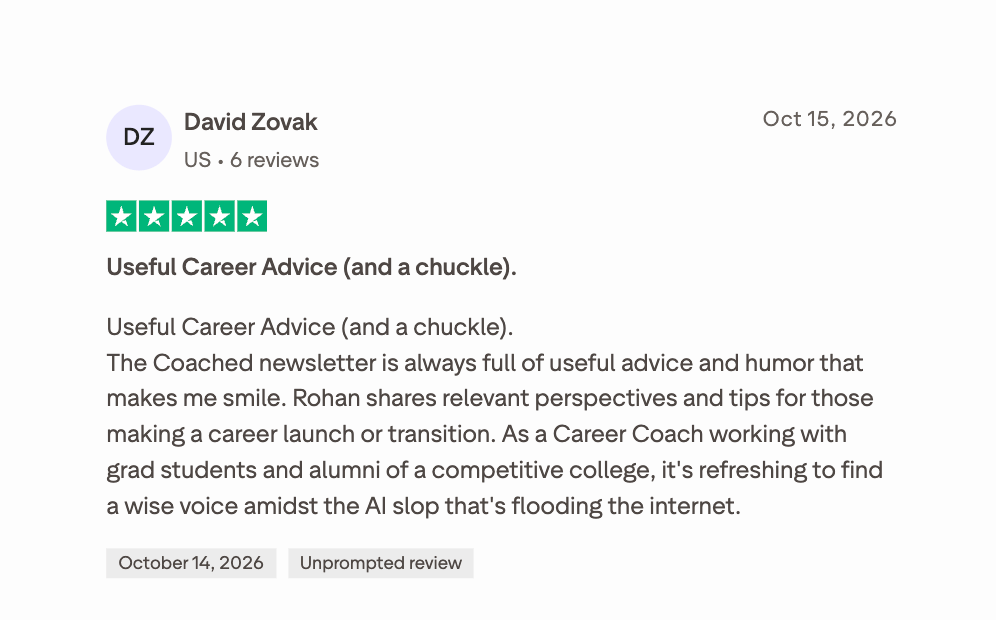
Thank you so much, David!
You can leave one here. I’d appreciate it. Thank you so much.
🤭 In all unseriousness
A few laughs to keep you smiling until next week
Don’t waste your time actually writing cover letters from scratch for each and every application. That doesn’t mean you should use ChatGPT/Claude though - they have tells which make it obvious to any hiring manager that it’s written by AI.
Use something like this AI cover letter tool that writes cover letters for you - it creates a story using your background that will fit what employers look for.
You should try it - the new resume rewriter features are pretty awesome. Upload your resume here and you get a free resume review.
⚡ Try our career tools
How strong is your resume?
Find out your resume's score based on millions of real data points


Is your LinkedIn profile getting you rejected?
Our AI tool will fix yours in a couple of minutes.


If you’re new here, join at Coached.com to get the next one.