
It’s easy to accept a salary, a price or a deadline you’re unhappy with because asking for something different feels uncomfortable. I think a lot of us worry that negotiating will make us seem difficult, when there’s often a perfectly reasonable conversation to be had. Today’s Mentor’s Corner is about making those conversations easier — and giving yourself a better chance of getting what you want.
This is Coached Weekly, my career notes where I share the tiny % of ideas that actually work in real careers. It takes 5 minutes to read, but could speed up your career by years. I write this myself (no AI) and I read your replies. —Rohan Mahtani (LinkedIn)

Mentor's Corner
Insights put together by me. One practical lesson a week that will make a measurable impact on your career, delivered right to you — for $0.
How to negotiate when you hate negotiating
How do you get what you want in life?
Whether that's convincing your boss to give you a raise, getting your partner to agree on Greece for vacation, or even talking your teenager out of that terrible tattoo idea...
Well…
If what you want involves other people (which most things do), then a lot of it boils down to just one skill:
Negotiation.
The sad part?
Despite being fundamental to getting almost anything we want, most people are terrible at it.
They either avoid it entirely or stumble through it hoping for the best.
So I wanted to share a few things I’ve learned about negotiating. Even if you’re not “negotiating” anything right now, I think it’s still worth the read - a lot of things are core human psychology that could help your day-to-day.
⚖️ What gives you room to negotiate?
Imagine you’re trying to negotiate the rent on an apartment with the owner.
It’s been empty for two months, the owner wants a tenant soon, and you’re ready to move in next week. The owner doesn’t want to lose out on another month of rent. Naturally, the owner will likely accept a lower offer.
Let’s now flip it.
That same apartment now has five applicants willing to pay the asking price. The owner now has options. If you went to the owner with the same lower offer, they’d turn it down.
Even though it’s the same offer, the circumstances are different.
That’s what “leverage” is, and if you’re negotiating anything, this is step #1: find out what their circumstances are, because that tells you how much you can negotiate. How much does each person need this agreement, compared with what they could do instead?
⚖️ It applies everywhere
For example, let’s say you spent 3 months interviewing at a big company. You’ve met with several hiring managers, a senior exec, and you’ve just been given a job offer.
You’d like to ask for a higher salary, but you’re scared that they might react badly or give the job to someone else. You’re not alone! Most people think this, and so they don’t negotiate.
But let’s look at it from the “leverage” angle. This big company has spent 3 months and senior people’s time interviewing you. That has cost them a lot. Finding an alternative means more interviews, more uncertainty, and more time with the job unfilled.
Offering you a higher salary is easier for them than doing all that again!
So don’t assume you have no leverage just because you’re negotiating with a big company. They have reasons to want this to work too. How urgently they need you, and whether they have another suitable candidate, matter more than how big they are.
🤝 People don’t always want the same thing
When negotiating a price, our instinct is often to compromise. You want 50, they offer 30, so you try to meet at 40.
But imagine this conversation:
“How would you like to buy our grass-fed steaks?”
“Ummm, I’m a vegan. I don’t eat meat.”
“How about we knock off 50% then?”
That would be delusional. But we do less obvious versions of this when negotiating: we keep improving an offer without finding out WHY the other person doesn’t want it.
People don’t always want the same thing - money is not always the #1 thing. You can find others. Often, the thing that’s easy for you to offer is surprisingly valuable to them.
I remember negotiating with a company that wanted to give its clients access to Resume Worded, our software for job seekers. They were interested, but were hesitant to proceed.
So I offered free training for their employees and the option to cancel early if it wasn’t working out. That closed the deal. The high price wasn’t the sticking point. They just needed to know they wouldn't regret buying something no one used. Once I found that out and offered it, they moved quickly. And they’re still a customer four years later!
Similarly, in a job negotiation, you might be focused on salary, while the employer is particularly concerned about your start date, a gap in the team, or someone being available to work with colleagues in Australia.
If starting sooner or occasionally working different hours is easy for you, that gives you something useful to offer in exchange for higher pay.
How do you find out what people want? Try this:
🤝 Use mirroring questions
“I can’t. It’s not in our budget.”
A rookie mistake here is replying, “Why?” or “Why not?”, which puts people on the defensive and turns negotiation into confrontation.
(“I don’t want to go to Mexico on holiday.”
“Why?”
“I just don’t, okay!”)
Instead, ask what Chris Voss, the FBI’s “go-to” negotiator in high-stakes hostage situations, calls a “mirroring question”:
“I don’t want to go to Mexico on holiday.”
“You don’t want to go to Mexico on holiday?”
“Yeah, just.. I dunno, I think I’d rather stay at home and spend time with family, you know.”
To do this, repeat what they’ve just said 1) as a question, and 2) with a rising tone at the end. It’ll come across as curiosity (not hostility), which’ll make them naturally open up and tell you what they’re thinking.
Here are some examples you can use at work:
If a colleague says, "I don't think your idea will work for our team," mirror back with, "You don't think it will work for our team?" This’ll get them to elaborate on their concerns, letting you address them directly.
When a client tells you, "This proposal is too expensive," try echoing, "The proposal is too expensive?" They’ll usually reveal more details of why, which will allow you to tailor something to them.
🌡️ Let off the pressure
Imagine you get a cold call from a stranger. Which opening question would make you feel more pressured:
A) Hey, you got a few minutes?
B) Hey, is this a terrible time to talk?
If you’re like me, Question A makes you feel way more pressured.
Why?
Because it’s trying to get you to do something.
Question B, on the other hand, puts very little pressure on you because it gives you a very easy “out” by almost assuming a “no” (which ironically makes you more likely to hear what the guy’s got to say.)
So remember:
“No-oriented” questions reduce pressure, whereas “yes-oriented” questions increase pressure.
Bad: Can we talk about salary?
Good: Would it be a terrible time to talk about salary?
🚪 Know what you’d turn down
Before negotiating, decide what you won’t agree to. That includes the price, but also any conditions that would make you regret the deal.
It's worth saying because a lot of people have a do-it-at-all-costs mentality. They get dazzled by a big name or a big number and end up agreeing to things they'd never normally accept, like a brutal commute, a fuzzy job title, or a manager who already gave them a bad feeling in the interview.
So know your dealbreakers. And be ready to walk away.
📦 Get comfortable with silence
Say you’ve received a job offer and asked whether the salary could be higher. The recruiter pauses.
“But it’s not a dealbreaker,” you add. “I’d be happy with the original offer too.”
They haven’t answered yet! They could be considering what’s possible or working out whose approval they’d need. You’ve already started taking the request back.
The ordinary communication basics help: speak slowly, explain your reasoning, keep your posture relaxed, and give the other person time to respond. You can always take time to consider their proposal offline instead of answering immediately.
Be thoughtful about what you volunteer. Explaining your priorities can help someone make a better offer. Immediately revealing your absolute minimum or maximum budget gives away different information.
🤖 Get some help figuring out your approach
One last tip: use AI to help you think through a negotiation before having it. Explain the situation and what you want. Then ask it to look at the negotiation from the other person’s side: what might they want, and what could make them hesitant to agree?
You can do this in Coached. The Ask Coached thing can use your career context, and if you take our personality test first, it’ll suggest negotiation techniques that suit your wiring.
If you’re introverted or non-confrontational, for example, it might help you put together a clear written request, so you don’t have to make your whole case on the spot.
If that’s something you want, I’d start with the 3-minute personality profile (totally free, costs $100s elsewhere).
I hope this helps you feel more prepared for the next one!
If you enjoyed this:
Forward it to a friend, family member or colleague. It’ll help them and also help me grow my impact/readership.
If someone you know is on a job search, tell them to check out Resume Worded. It’ll make their job search a lot shorter.
Speak soon,

Rohan Mahtani
Founder at Coached & Resume Worded
Btw, I like reviews. They motivate me to keep the quality high. Like this one:
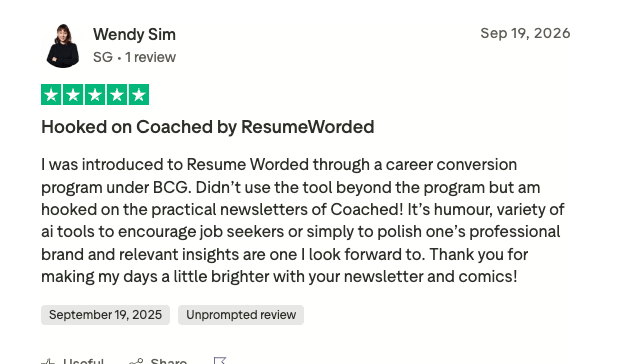
Made my day, thanks Wendy!
You can leave one here. I’d appreciate it. Thank you so much.
🤭 In all unseriousness
A few laughs to keep you smiling until next week
Try this word game!
Btw, I made a little word game called Clue Me. It’s a short 2-minute game like Charades or Taboo. Here’s my attempt today:
See if you can beat me 😉 Reply back with your score! (or post it if you want)
Don’t waste your time actually writing cover letters from scratch for each and every application. That doesn’t mean you should use ChatGPT/Claude though - they have tells which make it obvious to any hiring manager that it’s written by AI.
Use something like this AI cover letter tool that writes cover letters for you - it creates a story using your background that will fit what employers look for.
⚡ Try our career tools
How strong is your resume?
Find out your resume's score based on millions of real data points


Is your LinkedIn profile getting you rejected?
Our AI tool will fix yours in a couple of minutes.


If you’re new here, join at Coached.com to get the next one.