
Most career advice is about what move to make. I think when you make it matters almost as much. Getting onto a great team before everyone wants in is very different from joining once it’s already obvious. The same goes for leaving a company before its problems become public. Today’s Mentor’s Corner is about getting better at the timing.
This is Coached Weekly, my career notes where I share the tiny % of ideas that actually work in real careers. It takes 5 minutes to read, but could speed up your career by years. I write this myself (no AI) and I read your replies. —Rohan Mahtani (LinkedIn)
Want to log in to Coached or see your personality assessments? Login.
The 20-second Career tactic
I've coached people for a decade. Here's one idea that moves the needle. I teach it in 20 seconds.
Make asks while your win is still warm
People think there’s a “right time” to ask for things at work: during a review, in a 1:1, when budgets get set.
There is, but it has more to do with what just happened.
If you’ve just shipped something important, fixed a messy problem, or had a client praise your work, that’s a very good week to ask for more scope, headcount, a title conversation, or the project you’ve wanted. Your value is unusually easy to see.
The reverse is true too. If you just missed a deadline or something you owned went badly, you probably don’t want to make your biggest ask three days later just because your review happens to be on Thursday.
Managers have recency bias like everyone else. So use the calendar for the formal process, but time the actual conversation around when the evidence for your case is strongest.

Mentor's Corner
Insights put together by me. One practical lesson a week that will make a measurable impact on your career, delivered right to you — for $0.
Insider trading is legal in exactly one market
Insider trading is illegal in the stock market for a simple reason: it works too well. If you know the drug trial failed before the announcement does, you can't lose. So it’s banned, and people go to prison for it.
But there's a version of it that’s legal.
I’ll use an example to illustrate first. Take Nokia, the biggest mobile phone company in the ‘90s. When the iPhone came out in 2007, Nokia's engineers internally knew their phones couldn't compete with the iPhone - their software and hardware were years behind.
The outside world had no idea. To analysts and headlines, Nokia was still the giant of the industry and the iPhone was just a new entrant. But the people working at Nokia really knew how bad the situation was. In other words, they were holding exactly what an insider trader holds: information the market doesn't have yet (that “Nokia is screwed!”).
A few of them “traded” on it. They retrained, and moved to Apple and Google while Nokia on a resume still opened doors. Instead of trading money, they “traded” their careers. But the mechanics are the same - they knew something early because they were internal employees, and used it to do something about their careers.
Most did nothing. They waited for the information to become public and when Nokia's phone business was gone by 2013, everyone hit the job market at once - which was way harder.
My point is: If you’re working at a company, you probably know more about the state of your company, your industry, and yourself than other people. But are you using that information?
🤔 What "using it" actually looks like
Lemme give you three situations where people hold an edge and sit on it:
Things are bad, but you don’t act because of comfort: This is the Nokia situation. The product hasn’t really improved, or it’s being eaten by AI, the best people are leaving, and there are constant reshuffles. This is useful info: you’re seeing issues before management decides layoffs are necessary. “Using it” is getting closer to the faster-growing competitors, or building new skills - like the people who left Nokia early.
Move closer to the “good”. Say there’s an initiative at your company that’s doing very well. That’s inside information too. “Using it” means getting closer to that good, before it becomes the official center of the company and gets super competitive.
If you’re job searching: Most people apply to jobs based on big brand names, even though they aren’t necessarily the best companies. Use your own experience to build your search around where the opportunities are.
Almost everyone has that gap between what they know and what they're doing about it - it’s normal! I want to dig into why.
🕰️ Why nobody “trades” it
We don’t act on stuff like this because we’re often waiting for one of three confirmations: the numbers to show it, someone official to say it, or the move to finally feel justified.
The numbers arrive late. This is why most of Nokia’s engineers didn’t leave even though the writing was on the wall. Nokia had a record year in 2007, the year the iPhone came out. It just took time for the numbers to catch up. The cracks you see now show up in 3-4 years.
People wait for confirmation, and confirmation never comes. Researchers who studied Nokia's collapse found that middle managers were afraid to pass bad news upward. Execs had a reputation for shooting messengers, so at every layer of the company, reports got a little more optimistic. "We're in serious trouble" left the engineering floor and arrived at the top as "we're on track."
And the feeling of "now it's justified" comes last. Think about what "justified" actually means — it means the situation has become obvious enough that anyone would agree with you. But at that point it's not “inside information” anymore because everyone knows it. The edge was when the move was still a bit early.
🔍 If your read is fuzzy
If you're unsure what you know, here are a few things you can run that no outsider can.
Customer energy: Do customers still love the product the same way, or have things changed?
Pivot speed: When something clearly isn't working, does it get killed in a quarter, or does it limp along for two years? This tells you how fast your company admits mistakes — and companies that admit mistakes fast handle big shifts (like AI) much better.
And the big one right now: AI. Every company is currently figuring out how much of its work AI changes — and the official story about how that's going is the most delayed, most softened information in the building, for all the reasons above. Your inside view is far better.
Check whether leadership personally uses AI — not sponsors it, actually uses it, on their own work. It's hard to make good decisions about something you've never touched (imagine a CEO setting mobile strategy in 2008 who had never held a smartphone).
You can also see how AI is landing on your own role: which parts of your job it's already doing, which parts it can't touch. For a fast, structured read on that, get your AI impact map — enter your LinkedIn, and it maps where AI is landing in your specific role.
It’s free (for now, not forever!).
🤝 The trades themselves
Career trades are usually small. If things feel bad internally, the trade is spending your learning hours on the skill you'd need at your next role, and taking the occasional recruiter call while you still have a job.
If something's working, the trade is getting closer to it now — a coffee with someone on that team, volunteering for a piece of it — before it becomes official and everyone wants in.
If you're job searching, the trade is aiming your search at the corner of your industry you know is growing, instead of the famous names everyone else applies to.
Sometimes the trade is realizing you're in a good spot. Many companies pass these checks fine — the product's improving, good people keep joining, bad projects get killed. If that's what you find, great: you can ignore the scary layoff headlines about your industry, because you have better information about your own employer than any journalist does.
I hope you learned a thing or three. If you enjoyed this:
Forward it to a friend, family member or colleague. It does truly make a difference.
If someone you know is on a job search, tell them to check out Resume Worded. It’ll make their job search a lot shorter.
Speak soon,

Rohan Mahtani
Founder at Coached & Resume Worded
Btw, I like reviews. They motivate me to keep the quality high. Like this one:
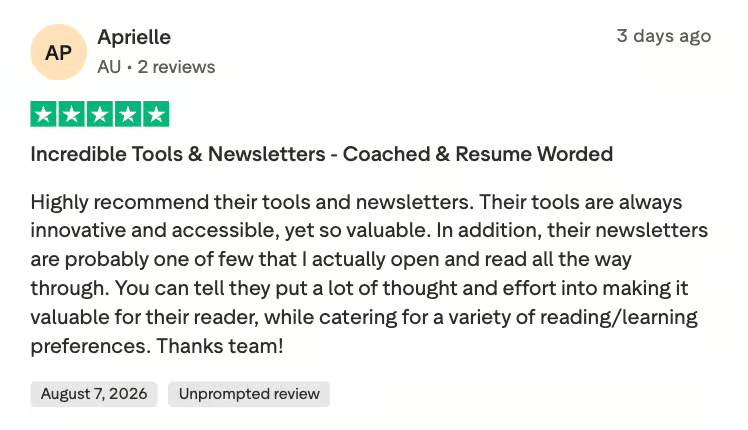
I appreciate that so much, Aprielle!
You can leave one here. I’d appreciate it. Thank you so much.
🤭 In all unseriousness
A few laughs to keep you smiling until next week
Don’t waste your time actually writing cover letters from scratch for each and every application. That doesn’t mean you should use ChatGPT/Claude though - they have tells which make it obvious to any hiring manager that it’s written by AI.
Use something like this AI cover letter tool that writes cover letters for you - it creates a story using your background that will fit what employers look for.
⚡ Try our career tools
How strong is your resume?
Find out your resume's score based on millions of real data points


Is your LinkedIn profile getting you rejected?
Our AI tool will fix yours in a couple of minutes.


If you’re new here, join at Coached.com to get the next one.