Your career depends on other people more than you'd like: which boss you pick, which company, which clients you trust. Today's Mentor's Corner is about the thing I look at first when making those calls — and why the same thing decides how people bet on you.
This is Coached Weekly, my career notes where I share the tiny % of ideas that actually work in real careers. It takes 5 minutes to read, but could speed up your career by years. I write this myself (no AI) and I read your replies. —Rohan Mahtani (LinkedIn)
Want to log in to Coached or see your personality assessments? Login.
The 20-second Career tactic
I've coached people for a decade. Here's one idea that moves the needle. I teach it in 20 seconds.
Ask "is this reversible?" to unstick any decision
Teams agonize over decisions as if every choice is permanent. Almost none are. There are two kinds of decisions: one-way doors (can't undo → quitting, firing, signing the big contract) and two-way doors (walk back through anytime → the tool, the format, the process tweak).
The unlock is that most decisions at work are two-way doors being debated like one-way doors. So when a meeting is stuck in week two of "evaluating options," ask:
"Is this reversible? If yes — can we pick one and revisit in two weeks?"
Save the agonizing for actual one-way doors; they're rarer than you think. Even “big” life decisions like moving countries seem irreversible, but they’re more reversible than you think. When a decision is truly irreversible, slow down and take more time than you think you’d ordinarily need.

Mentor's Corner
Insights put together by me. One practical lesson a week that will make a measurable impact on your career, delivered right to you — for $0.
Integrity is a career strategy
One day, a former motorbike racer named Elias got a call at his shop. A film production company wanted a rare Italian motorcycle — one of only seven left in the world — for a famous actor to ride and crash in a movie.
"We'll pay you anything," the guy tells Elias. "We have a huge movie budget." The finder's fee alone was around $250k, at a time when Elias's business was small.
Elias refused. "There are seven of these left in the world. I'd never be involved in destroying one, no matter how much you offer."
The story spread, and every serious collector who heard it learned something Elias's marketing could never have told them: this man will protect what I care about even when it costs him a fortune. The people with the rarest machines and the biggest deals now had exactly one obvious person to call. Over the following years, that lost $250k came back many times over — a bike collector here, a referral there, deals that never went to a competitor because there was no reason to risk one.
The usual moral is "integrity pays." True — but I love this topic too much to stop there: Your career is a long series of bets on people — which boss, which company, which client — and integrity is the variable that decides how those bets pay off.
🔍 Character leaks. Read the previews.
The single most useful rule for reading people: character doesn't compartmentalize. People believe it does — "he's ruthless in deals but he'd never screw me" — and they're almost always wrong.
Whoever will lie for you will eventually lie to you. The salesman who bends the rules to win your deal has shown you his operating system, and one day it will run on you. The colleague who gossips with you is gossiping about you in other rooms — you're seeing the behavior, just not your turn.
So treat every small display as a preview. Whenever you catch yourself thinking "that's just how they are with other people," replace it with: this is how they'll be with me, once I'm on the wrong side of a decision. Pay extra attention to how people treat you while they still need something from you — that's the nicest they will ever be — and to how they treat people who can't do anything for them anymore.
And trust your gut on this. When you can feel that someone wants something from you, or that something about a person is off, that feeling is helpful. It's you noticing a dozen small things you can't name yet. Most people talk themselves out of it because they can't produce evidence. You don't need evidence to slow down and be more careful.
It cuts both ways, of course. Badmouth your boss in an interview and they hear how you’ll talk about them next!
🤫 Nobody tells you when you've lost them
Think of someone you've stopped trusting. Did you ever tell them? Probably not. There was no confrontation. You just moved them into a different category — stopped telling them real things, stopped bringing them opportunities, kept it polite. As far as they know, everything is fine.
Everyone does this. Which means it’ll likely happen to you too, and you won't get a memo either!
It's also why some damage can't be repaired: once you've seen what someone does when they think it doesn't count, an apology might change their behavior going forward, but it can't change what you now know about them.
👔 The integrity that matters most isn't even yours
Your raise, your promotion, your credit for good work — all of it passes through your manager's hands.
Their integrity affects your career more than your own does. A fair boss at an average company will fight for you and give you credit in rooms you're not in. A brilliant snake at a prestigious company will absorb your credit and trade you away the moment it's useful.
Most people pick jobs by brand and salary and treat the manager as furniture. Flip that weighting: when you interview, audition them back. Listen to how a prospective boss talks about people who've left. That answer predicts your next three years better than anything on the offer letter.
🎭 Integrity doesn't mean being an open book
People who take integrity seriously often make a specific mistake: they over-share because withholding feels dishonest. It's not. Volunteering your bottom number in a negotiation isn't integrity, it's just bad negotiating. Telling a colleague what you really think of the CEO isn't transparency, it's just reckless.
Integrity means what you say is true. It doesn't mean you owe anyone everything you know. Learn the difference — the people who can't tell "honest" from "naive" get eaten by the people who can.
🔥 Yours only gets built when it costs you
Saying "I'm honest" builds nothing, because anyone can say it. Being honest when it's convenient builds almost nothing, because everyone is. A reputation is built by honesty that visibly costs you — the one version nobody can fake. Elias didn't lose $250k. He spent it on the one advertisement no budget can buy.
Most of your moments won't be that big, and that's fine — the daily reps are small: tell people the thing they won't like before they find it out on their own. Give credit accurately, especially when nobody would notice you taking it. When someone tells you something privately, keep it to yourself. Offer to help a buddy when there’s nothing in it for you and it’ll eat your time.
In professional and personal relationships, the math is asymmetric. You can have a great relationship with someone, and one caught lie doesn't cost one point — it makes every unwatched moment suspect at once. Decades of deposits basically get repriced in five minutes.
🤝 What it ultimately buys: better rooms
Trustworthy people can only afford to work with trustworthy people — anyone else eventually burns them. So over time, integrity sorts you. Keep yours and opportunities will find you.
Cut corners, and you sort the other way, into the company of people who also cut corners. Yes, you'll watch some people cheat and win. Look at who they get to spend their careers with now. The real punishment for a snake is a career (and life!) surrounded by other snakes.
It’s also just a useful decision framework when you’re facing a tough choice. What’s the right thing to do? The answer is usually very clarifying and lets you sleep better at night.
I hope you learned a thing or three. If you enjoyed this:
Forward it to a friend, family member or colleague. It does truly make a difference.
If someone you know is on a job search, tell them to check out Resume Worded. It’ll make their job search a lot shorter.
Speak soon,

Rohan Mahtani
Founder at Coached & Resume Worded
Btw, I like reviews. They motivate me to keep the quality high. Like this one:
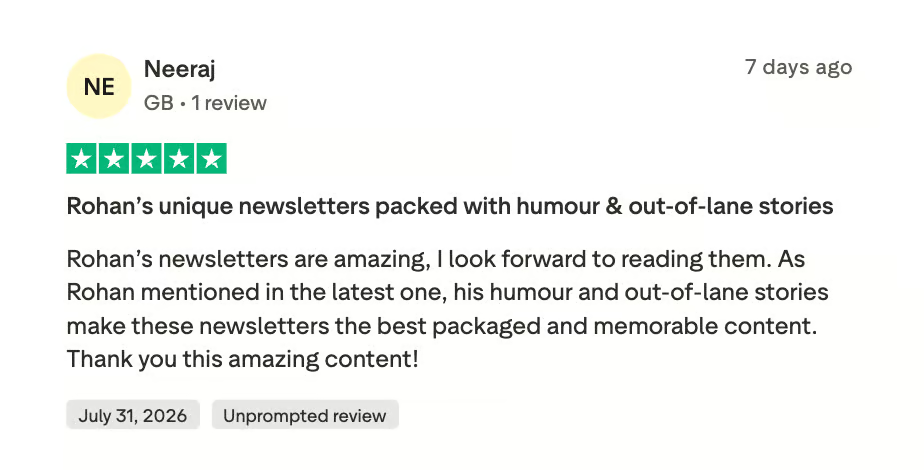
Thanks Neeraj!
You can leave one here. I’d appreciate it. Thank you so much.
🤭 In all unseriousness
A few laughs to keep you smiling until next week
Don’t waste your time actually writing cover letters from scratch for each and every application. That doesn’t mean you should use ChatGPT/Claude though - they have tells which make it obvious to any hiring manager that it’s written by AI.
Use something like this AI cover letter tool that writes cover letters for you - it creates a story using your background that will fit what the employers look for.
⚡ Try our career tools
How strong is your resume?
Find out your resume's score based on millions of real data points


Is your LinkedIn profile getting you rejected?
Our AI tool will fix yours in a couple of minutes.


If you’re new here, join at Coached.com to get the next one.