Take any career or industry that stalled and trace it backwards, and you'll usually find a moment where the warning was visible and ignored. So: what's the thing in your career that will seem obvious in five years, that you're ignoring right now? Today's Mentor's Corner is about why it's so hard to see from the inside, and how to find it before it finds you.
This is Coached Weekly, my career notes where I share the tiny % of ideas that actually work in real careers. It takes 5 minutes to read, but could speed up your career by years. I write this myself (no AI) and I read your replies. —Rohan Mahtani (LinkedIn)
Want to log in to Coached or see your personality assessments? Login.
The 20-second Career tactic
I've coached people for a decade. Here's one idea that moves the needle. I teach it in 20 seconds.
Write emails people can answer from their phone
A habit worth building early: whenever you write to someone, do the thinking on your side, so all that's left on theirs is a decision. "Thoughts on this?" hands them work — they now have to figure out what you're really asking, form a view, and compose an answer.
"I'd go with Option B because it's faster to ship — good to proceed?" hands them a choice. One thumb, done, from anywhere.
Almost every message you send can pass this test. Status update? Lead with the one line they care about, not the journey. Need an intro? Include the forwardable blurb so they don't have to write one. Flagging a problem? Attach your suggested fix and ask "any objection?"
Why do this? You hit less friction, you actually get replies (especially from senior people, who basically live on their phones), and you're not that guy sending the 8th "just following up on this!" email.

Mentor's Corner
Insights put together by me. One practical lesson a week that will make a measurable impact on your career, delivered right to you — for $0.
Why smart people miss what's coming
It's hard to comprehend how bloody WW1 was. The French army alone lost 300,000 men in the first nine days.
The part that makes it worse: the generals running those battles weren't fools. They were the best military minds of their generation, men who had won real wars with cavalry (aka soldiers fighting on horseback). That was exactly the problem. Because the machine gun had just showed up and everything they knew about horses and swords was over.
They did what people do when the truth is expensive: they refused to look at it. They kept drilling soldiers to charge on foot across open ground — and canceled the order for a promising new invention called the tank.
Blind spots in life operate the same way. The information you need is often available; the generals were literally handed the tank. What's missing is the willingness to look, because looking has a price — it can cost you your expertise, comfort, or story you tell about your own path. Here's where it happens most, and what to do about it.
🚫 We dismiss whatever threatens us
In 1975, a Kodak engineer named Steven Sasson built the world's first digital camera and showed it to management. Their response, roughly: interesting, now put it away.
I find this so interesting because Kodak didn't actually miss digital photography. They built it internally first — and buried it, because taking it seriously meant admitting their film business would die.
Here's how to spot the same blind spot in yourself: pay attention to your emotion. When you feel the urge to scoff at something new in your industry — "AI code is garbage," "TikTok is for kids," "no serious client would buy that way" — there's a chance you've stopped analyzing the thing and started protecting yourself from it. And the better you are at the old way, the stronger the urge to scoff. Success is a sedative.
So treat your own dismissal as an alarm. When you catch yourself rolling your eyes at something new in your industry, give it one honest hour: use the tool, read the report, talk to someone actually doing it. If it really is nothing, you've lost an hour. If it isn't, you've found the exact spot where you are choosing not to look.
📡 We only see what our inputs show us
Two years before the 2008 financial crash, the investor Michael Burry figured out the housing market was a time bomb, bet against it, and made $700 million. The dude seems like a genius but he wasn’t smarter than thousands of quants on Wall Street. What he did differently, though, was he read different material: while everyone else read the ratings and the headlines, Burry read the actual mortgage documents, and saw thousands of loans that were obviously going to default.
Your view of your industry is built the same way — from your inputs. If everything you know arrives secondhand through your company (your boss, your Slack, your all-hands), you're seeing the industry the way your company sees it, blind spots included.
Two cheap ways to fix your inputs. Every couple of months, read the job postings for your role at other companies: postings are companies publicly declaring which skills they'll pay for next. And once a quarter, talk to someone who left your company or your field. People who've left have no reason to keep telling the official story.
And for the fastest input upgrade: get your AI impact map. Enter your LinkedIn, and it maps where AI is landing in your specific role. If you haven't done that yet, it's probably your biggest unexamined input.
📈 We judge what things are, not what they're becoming
That digital camera Kodak buried was genuinely bad. It weighed 8 pounds, shot blurry black-and-white photos, and took 23 seconds to save a single picture onto a cassette tape. So it was easy for management to shrug — ‘film cameras are so much more portable!’
But "is it good?" was the wrong question. The right question was "how fast is it improving?" Film hadn’t changed in decades. Digital was doubling in quality every two years. Kodak should have tracked the progress, and moved the moment it got close. They waited way too long.
The same mistake repeats today. People try AI once, get a mediocre result, and conclude it's overhyped. They've judged the snapshot. Judge the speed instead: compare the thing to itself two years ago, not to your standards today. If it's improving fast, it will meet your standards soon enough — and it's better to be early than surprised.
👀 Everyone can see your blind spots except you
The strange and annoying thing about our blind spots is they’re only invisible to us.
You can often diagnose your friend's career in seconds: what skill’s probably becoming more important or what other industries are clearly booming. The people around you can diagnose yours just as fast - but we don’t ask.
So ask - maybe close friends, or even people somewhat related to your industry. The question that works: "What's something about my career/industry that's obvious to you, but I probably can't see?" People often have an answer ready.
Borrow the newest eyes around you, too. Juniors can spot industry shifts, because they have little invested in the traditional ways. This goes the same with people from other industries - they might offer a fresh perspective.
And for a systematic outside read, our research lab built a free tool for exactly this: the Career Deep Read. Give it your LinkedIn, and it maps your patterns — what you keep gravitating toward, what you keep avoiding, the decisions you've been making on autopilot. It's the closest thing to seeing your career the way an outsider does.
It’s free (for now, not forever). And the rest of Coached has tools for working through other things in your career — figuring out direction + your strengths.
⚖️ Would you take your job today?
Investors have a simple trick for deciding whether to sell a stock.
Say you bought Apple at $100, and today it's at $500. Should you sell to lock in the win? Or could it go higher? It's confusing, because you’re thinking about the past and how much you started with.
So investors ignore all of that and ask one question about the present: would I buy Apple today, at $500? If yes, keep it. If no, sell it. The past - what you bought it for - doesn't matter. Only whether it's a good deal today.
Now use the same trick on your job. Instead of "should I stay?", ask: if this job were offered to me today, would I take it?
Ask it once a year. If the answer is yes — great, you're staying because you want to. If the answer is no, don't quit tomorrow. It’s useful early data. You can start planning and looking around, slowly, for something you would say yes to.
Hopefully that’s a piece of advice you haven’t heard before. If you enjoyed this:
Forward it to a friend, family member or colleague. It does truly make a difference.
If someone you know is on a job search, tell them to check out Resume Worded. It’ll make their job search a lot shorter.
Speak soon,

Rohan Mahtani
Founder at Coached & Resume Worded
Btw, I like reviews. They motivate me to keep the quality high. Like this one:
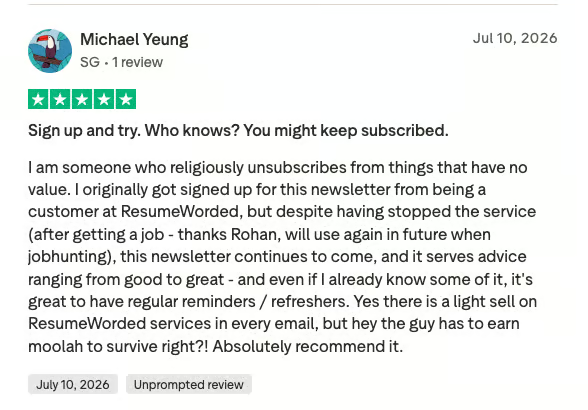
Thank you Michael!
You can leave one here. I’d appreciate it. Thank you so much.
🤭 In all unseriousness
A few laughs to keep you smiling until next week
Don’t write a new cover letter from scratch for each and every application. Use something like this AI cover letter tool that writes cover letters for you - it creates a story using your background that will fit what the employers look for. And no one can tell it’s AI (unlike with ChatGPT/Claude).
⚡ Try our career tools
How strong is your resume?
Find out your resume's score based on millions of real data points


Is your LinkedIn profile getting you rejected?
Our AI tool will fix yours in a couple of minutes.


If you’re new here, join at Coached.com to get the next one.