I've noticed most career advice about AI comes from people who can't explain how AI works — which is probably why the advice keeps aging so badly. I've spent years on the technical side of this stuff, so in today's Mentor's Corner, I’ll de-mystify how AI actually learns and from there, give you a strategic way to think about your own career.
This is Coached Weekly, my career notes where I share the tiny % of ideas that actually work in real careers. It takes 5 minutes to read, but could speed up your career by years. I write this myself (no AI) and I read your replies. —Rohan Mahtani (LinkedIn)
Want to log in to Coached or see your personality assessments? Login.
The 20-second Career tactic
I've coached people for a decade. Here's one idea that moves the needle. I teach it in 20 seconds.
Ask "is this a priority or are you thinking out loud?"
A weird dynamic you’ve probably experienced: the more senior someone is, the more their offhand comments get treated as orders. A VP muses "have we ever looked at X?" in a meeting, and someone burns two weeks building a deck on X — that the VP didn’t really care about.
So when your boss floats something, just ask: "Is this a priority, or thinking out loud?" They'll tell you, and half the time it's "oh no, just musing." You just saved 2 weeks.
And if you're the senior person: label your musings. "Not a request, just wondering aloud" prevents your team from silently reprioritizing around your shower thoughts.

Mentor's Corner
Insights put together by me. One practical lesson a week that will make a measurable impact on your career, delivered right to you — for $0.
Does your work have an answer key?
A few years ago, the consensus on AI went like this: routine jobs fall first — drivers, warehouse work, data entry — while creative work stays safe. Then language work — like translation or customer service — took a hit, years before truck drivers did. Then AI got genuinely good at coding, the profession everyone assumed would be doing the automating, not receiving it.
The predictions kept failing because people didn’t understand how AI actually works - and thus were sorting jobs on the wrong axis. The axis that actually predicts what AI will get good at: does the task have an answer key?
This is the crux of how AI works, and you don’t need to be technical to understand it. I’ll try to explain it to you simply - all I need is 2 minutes.
🧩 How AI really works
AI learns the way people learn: by practicing. It tries a task, checks whether it got it right, adjusts, and tries again — except it runs that loop millions of times, at a speed no human can match.
The important word in that sentence is checks. Practice only improves you when you can tell which attempts worked. A kid shooting free throws gets better because every shot answers him: in, or out. That’s the answer key. Blindfold him so he can’t see if he makes it, and he can shoot all night without improving.
That same rule decides everything AI is elite at. Chess: every game ends in a clear win or loss, so AI could play itself endlessly, always knowing what worked — and became superhuman. Coding: the code passes the tests or it doesn't. Translation, math, summarizing a document: all checkable, all falling fast.
Now flip it. Was this the right product to build? Did the client actually love the proposal, or were they being polite? Is this the quarter to push for expansion? Questions like these have no answer key. The results arrive slowly, and even then, people argue about them. So AI can attempt them a million times and never know whether it's improving. It's the blindfolded kid. It cannot get relentlessly good at what can't be graded.
So the skills worth building are the ones with no answer key. Three of them I think are most important:
🔍 Learn to FIND problems, not just solve them
In school, the problem was always handed to you. Early careers repeat the pattern: someone senior defines the task, you execute it. These are ‘answer key’ tasks. Executing well-defined tasks is precisely what AI does best.
What no tool does is scan your company and notice "sales and product haven't actually spoken in six months" or "we're pricing this for customers we no longer have." Someone has to see it.
So keep a running list of things at work that are broken, slow, or costing money — especially the ones nobody officially owns. Then bring one forward with a clear case for why it matters. The person who defines the problem ends up directing the work on it, and there's no answer key for "what should we be working on?"
🏁 "Pretty good" is now free — so it's worth nothing
The median output in most fields is now whatever AI produces from a lazy prompt: a decent draft, design, or analysis is available instantly to everyone including your colleagues and competitors. When something becomes free, it stops being valuable.
So the difference between you and the median has moved entirely into the last mile: the judgment calls, the specifics only you noticed, the revision that makes the thing land with this client. The gap between "done" and "excellent" is only getting more important. When AI saves you three hours, resist producing three more things — spend the hours making one thing excellent.
🎤 Practice the skills nobody ever graded
The most valuable skills now are the ones that never had an answer key in the first place.
Your reputation is the big one: good work, known by capable people who'll vouch for it. No one hands you a score for it, but it decides which rooms you're in. And live performance — presenting, fielding hard questions, thinking on your feet — is your judgment on display in real time. If you invest in one skill this year, speaking well in rooms is a strong pick.
📈 There will be more work, not less
One more thing, because the doom headlines skip it: when work gets cheaper, we've never done the same amount of it. We do vastly more. Spreadsheets were supposed to end accounting; instead, analysis got so cheap that demand for it exploded, and analyst jobs multiplied even as manual bookkeeping vanished.
The same shift is underway now. Most jobs won't disappear — they'll be redefined around higher expectations. You'll be asked to produce what a small team used to, with AI doing the answer-key layer. Which means fluency with AI and knowing what parts you can hand it is pretty useful. My advice there: ignore the flashy new tool of the week. There are so many! Just use the ones you use already (likely ChatGPT, Claude, and Coached 😉) and use them deep.
🗺️ Where the line falls in YOUR job
So the strategy in one line: let AI have the answer-key work, and deliberately shift your weight onto the rest — finding problems, owning the last mile, practicing the ungraded skills. That side is often the most interesting part of the job too.
For example: A marketing manager writes copy, analyzes numbers, briefs designers, manages a difficult client, and decides next quarter's plan. The first three have answer keys. The last two don't.
Where exactly the line falls is different in every field, and it moves every few months. Our research lab built a free tool for this — the AI Impact Map. Enter your LinkedIn URL, and in about 10 seconds it maps where AI is landing in your specific role and what to build on. It's the analysis a good career strategist would walk through with you, minus the strategist's invoice.
It’s free (for now, not forever). And if you want to go deeper from there, the rest of Coached has tools for working through other things in your career — figuring out direction + your strengths.
Hopefully that’s a piece of advice you haven’t heard before. If you enjoyed this:
Forward it to a friend, family member or colleague. It does truly make a difference.
If someone you know is on a job search, tell them to check out Resume Worded. It’ll make their job search a lot shorter.
Speak soon,

Rohan Mahtani
Founder at Coached & Resume Worded
Btw, I like reviews. They motivate me to keep the quality high. Like this one:
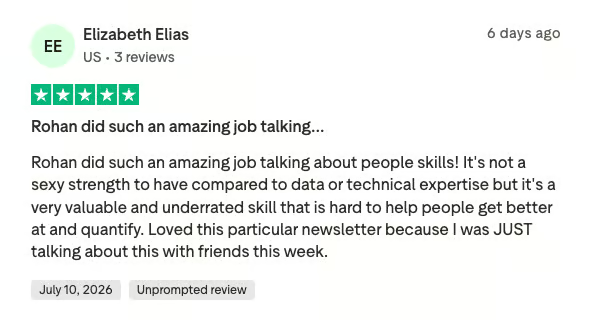
Thanks Elizabeth!
You can leave one here. I’d appreciate it. Thank you so much.
🤭 In all unseriousness
A few laughs to keep you smiling until next week
Don’t write a new cover letter from scratch for each and every application. Use something like this AI cover letter tool that writes cover letters for you - it creates a story using your background that will fit what the employers look for. And no one can tell it’s AI (unlike with ChatGPT/Claude).
⚡ Try our career tools
How strong is your resume?
Find out your resume's score based on millions of real data points


Is your LinkedIn profile getting you rejected?
Our AI tool will fix yours in a couple of minutes.


If you’re new here, join at Coached.com to get the next one.