
Some people can walk into a room full of strangers and leave with three new friends. For years I assumed that was a personality type. It's not — it's a skill, and a learnable one. Today's Mentor's Corner is about how to talk to just about anyone, including the version of you that swears they can't.
This is Coached Weekly, my career notes where I share the tiny % of ideas that actually work in real careers. It takes 5 minutes to read, but could speed up your career by years. I write this myself (no AI) and I read your replies. —Rohan Mahtani (LinkedIn)
Want to log in to Coached or see your personality assessments? Login.
The 20-second Career tactic
I've coached people for a decade. Here's one idea that moves the needle. I teach it in 20 seconds.
A 30-minute meeting doesn't cost 30 minutes
For managers, meetings are the job — their day is already chopped into hourly slots, so one more costs exactly one slot. But for anyone doing deep work (coding, writing, analysis), a 2pm meeting doesn't cost 30 minutes. It costs the whole afternoon: the morning is spent knowing it's coming, and real focus can't spin up in the fragments around it.
Two takeaways. If you do deep work: stop scattering meetings across your calendar and herd them to the edges of the day — one protected 4-hour block beats six free 40-minute gaps. If you're a manager: know that every "quick sync" you drop into someone's 2pm is way more expensive to them than to you. It’s often better to stack your asks against their existing meetings.
Heads up:
Working on your resume or know someone who is?
Don’t forget that you can get a free resume review here.
It’ll speed up your job search (or your friend’s).

Mentor's Corner
Insights put together by me. One practical lesson a week that will make a measurable impact on your career, delivered right to you — for $0.
How to talk to just about anyone
With your best friend, you can talk for three hours without trying. Put the same you next to a stranger at a work dinner, and you're checking your phone within four minutes.
Same person, same mouth. So the difference was never personality. With your friend, two conditions are met: you have live topics to pull on, and you're not monitoring yourself. With the stranger, you have neither. That's the whole skill of "talking to anyone" — finding a live topic fast, while staying out of your own head.
Both parts are learnable.
🔦 Get out of your own head
Hard conversations are hard because you're watching yourself have them. The senior person intimidates you, so you start performing — editing every sentence — and performing is precisely what makes you flat. Curiosity and self-consciousness compete for the same attention. You only get one.
Two findings make dropping the self-monitoring easier. In a Cornell study, students walked into a room wearing an embarrassing t-shirt, then guessed how many people would remember it. They guessed half. Fewer than a quarter did. And in research on what's called the liking gap, strangers talked and then rated each other — and people consistently underestimated how much the other person liked them.
Nobody is grading you as hard as you are, and the average conversation goes better than you think. Spend the attention on them instead.
🎣 Give them something to grab
A conversation survives only if each answer gives the other person something to respond to. "How was your weekend?" "Good. You?" leaves them nothing — they have to invent a topic from zero, and most people politely give up.
Answer with one specific detail instead: "Good — I tried a pottery class and made something genuinely hideous." Now they have three easy follow-ups, and you've done their work for them.
Apply this hardest to the question you'll get a thousand times: "What do you do?" "I'm in marketing" sounds like everyone. "I run marketing for a company that sells hot sauce to firefighters" starts the conversation by itself. If you want your version of that line, our research lab built a free tool called the Elevator Pitch — it reads your LinkedIn and tells you what to lead with.
And if you want to go deeper from there, the rest of Coached has tools for working through other things in your career — figuring out direction + your strengths.
⛏️ Drill until you hit a live topic
People you "can't talk to" are almost always people whose topic you haven't found yet. The quiet accountant is dull about accounting and electric about rock climbing. Most people ask two questions, get two flat answers, and conclude "we didn't click." They quit one question early.
The drilling tool is the follow-up question. When an answer has any energy in it, ask a second question about the same thing, then a third — "How did you end up doing that?" beats jumping to "So, where do you live?" Hopping between topics is what makes conversations feel like interviews. When their energy visibly jumps, you've struck the topic. Stay on it.
🚪 Someone has to go first
Small talk doesn't drag on because two people lack chemistry. It drags on because both people are waiting for the other one to say something real first. Neither wants to overshare with a near-stranger, so both stay safe, and the conversation stays beige. Depth isn't something you find in a conversation. It's something one person has to offer first.
Psychologists have tested this directly: in a famous study, pairs of strangers who answered gradually more personal questions felt closer after 45 minutes than many long-time acquaintances do. People match whatever level of realness you set.
So in the right settings, set it. One honest admission is plenty: "Honestly, I almost skipped tonight, I barely know anyone here." They’ll often meet you there. The person who "can talk to anyone" is mostly just the person willing to go first.
🧗 The actually hard cases
The one-word answerer. Your instinct is to ask more questions, but questions demand effort from someone who isn't giving any. Switch to statements: an observation, a small story, a hook of your own. "I heard the offsite got rained out — apparently they played poker in a parking garage for four hours." A statement costs them nothing to respond to, and it quietly shows them how to hold up their end.
The intimidating senior person. Everyone who approaches them either performs or interviews them about work — they get both all day. The memorable move is being normal: ask the human question everyone else is too nervous to ask, react honestly, disagree lightly if you actually do. You won't out-credential a VP anyway. Be the one relaxed conversation in their day.
The cold open. People stall for ten minutes composing the perfect opener. The opener's only job is to exist — nobody remembers first lines, only whether the conversation went anywhere. Comment on whatever you're both looking at ("How do you know the host?") and let the earlier moves do the rest.
🧱 One thing talking can't do
Being good with people multiplies whatever you're actually good at — gets it noticed, gets you remembered and recommended. A multiplier needs something to multiply, so if you ever have to choose, get genuinely good at something first.
But the more common mistake runs the other way: talented people who assume the work speaks for itself, and often lose to slightly less talented people everyone enjoys having in the room.
Hopefully that’s a piece of advice you haven’t heard before. If you enjoyed this:
Forward it to a friend, family member or colleague. It does truly make a difference.
If someone you know is on a job search, tell them to check out Resume Worded. It’ll make their job search a lot shorter.
Speak soon,

Rohan Mahtani
Founder at Coached & Resume Worded
Btw, I like reviews. They motivate me to keep the quality high. Like this one:
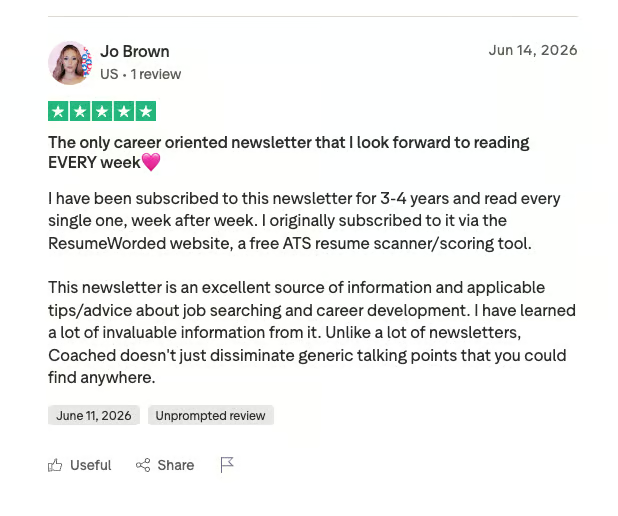
Thanks Jo!
You can leave one here. I’d appreciate it. Thank you so much.
🤭 In all unseriousness
A few laughs to keep you smiling until next week
Don’t write a new cover letter from scratch for each and every application. Use something like this AI cover letter tool that writes cover letters for you - it creates a story using your background that will fit what the employers look for. And no one can tell it’s AI (unlike ChatGPT).
⚡ Try our career tools
How strong is your resume?
Find out your resume's score based on millions of real data points


Is your LinkedIn profile getting you rejected?
Our AI tool will fix yours in a couple of minutes.


If you’re new here, join at Coached.com to get the next one.