Your raise, your promotion, your reputation — all of it gets decided by other people's impressions of your work. And impressions don't form fairly. In today's Mentor's Corner, I cover why great work often gets undervalued, and a few practical ways to make sure yours isn't.
This is Coached Weekly, my career notes where I share the tiny % of ideas that actually work in real careers. It takes 5 minutes to read, but could speed up your career by years. I write this myself (no AI) and I read your replies. —Rohan Mahtani (LinkedIn)
Want to log in to Coached or see your personality assessments? Login.
The 20-second Career tactic
I've coached people for a decade. Here's one idea that moves the needle. I teach it in 20 seconds.
Whoever writes the recap decides what was decided
Meetings end fuzzier than you'd think — everyone leaves with a slightly different version of what was agreed. The person who sends the follow-up ("here's what we decided, who owns what") is the one whose version becomes reality.
If you're junior, this is a cheat code. Taking notes seems like the low-status job nobody wants — which is why nobody fights you for it. But the note-taker frames the decisions, sets the action items, and can even slip in their own ideas ("things to explore next week: ..."). Your idea is now on the official agenda, no argument needed.
And if you're a manager, don't skip this either: the decision you think you got isn't real until it's written down. Otherwise everyone walks out with whatever version suits them — and you're re-litigating it in three weeks.
Heads up:
Working on your resume or know someone who is?
Don’t forget that you can get a free resume review here.
It’ll speed up your job search (or your friend’s).

Mentor's Corner
Insights put together by me. One practical lesson a week that will make a measurable impact on your career, delivered right to you — for $0.
How your work actually gets judged
There's a story about a locksmith I think about a lot.
As an apprentice, he was slow. Opening a jammed lock took him an hour of visible struggle, and customers watched him work for it, paid the full fee, and tipped him on top. Years later, he could open the same lock in two minutes. He was better at his job in every way. And customers started complaining about the price, and the tips stopped.
Every important outcome in your career — the raise, the promotion, your reputation — is decided by other people, based on their impression of your work. And impressions don't form fairly.
They form through a few predictable quirks of human judgment, and those quirks regularly make good work look worth less than it is. That's what happened to the locksmith: his work got better, but in his customers' eyes, its value dropped. Once you know the quirks, you can stop the same thing happening to you.
⚒️ Quirk 1: People judge the effort they can see
The locksmith's customers were really paying for the hour of struggle they watched. When the struggle disappeared, the price suddenly felt unfair — even though the result got better.
Researchers call this the labor illusion, and businesses design around it: travel sites show "searching 500 airlines..." with a slow progress bar because instant results feel cheap. Similarly, when using AI, responses seem more trustworthy if there’s been a lot of “thinking” time by the AI.
This quirk punishes skilled people hardest. As you get better, difficult things look easy in your hands, and people quietly lower their estimate of your work. The analysis you turned around in one day reads as one day of work — the ten years that made a one-day turnaround possible are invisible.
So when you deliver something difficult, say so. One sentence is enough: "This looked simple, but the data was a mess and I had to rebuild it three times."
And when someone praises your work, stop the reflexive "oh, it was nothing" we all say. They'll take you at your word. Say “It was a grind so I’m glad it was worth it!”
📅 Quirk 2: Recent work counts far more than it should
At your review, your manager answers one question — how did this person do this year? — from memory. And memory massively overweights the last few weeks. A strong year ending in one bad month gets remembered as a bad year. An average year that ends with a visible win gets remembered warmly.
Two ways to use this:
Time your requests. Ask for the raise or the bigger project right after a win, while it's the freshest thing in their memory of you. Just made a mistake? Wait, deliver your next win, then ask. The same request gets a different answer depending on the week.
Keep a win log. Every Friday, spend five minutes noting what you finished, fixed, or handled. Bring the list to your review, and your manager judges your actual year instead of their three-week memory of it. Bonus: updating your resume becomes copy-paste (Resume Worded will optimize it for free).
📉 Quirk 3: A loss feels twice as big as a gain
One of psychology's most repeated findings, from Daniel Kahneman and Amos Tversky: losing something feels about twice as strong as gaining the same thing. The pain of losing $100 is roughly double the pleasure of winning $100.
This matters because most proposals can be framed as a gain or as a loss — and the loss version is far more persuasive. Say you want your company to buy a tool. The gain version: "this could help us win more clients." Your manager hears a nice-to-have, and the decision slides to next quarter. The loss version: "we're losing about two deals a month to competitors who already use this." Now waiting has a price, and the decision happens this week.
So before any pitch, ask: what are we losing right now by not doing this? Lead with that. Just keep the loss true and specific — invented losses destroy trust fast.
🍪 Quirk 4: Incentives beat instructions, every time
Every workplace gives people two sets of directions.
The official set: instructions, stated values, what the boss asks for.
The real set: what actually earns them money, promotions, or praise.
When the two conflict, people follow the real set — usually without realizing it.
The company Xerox learned this the expensive way. Back in the day they released a new printer that was much better than their old model, even in terms of price. But the old one kept outselling it. The reason: salesmen earned a higher commission on the old machine. Management said "sell the new printer." The paycheck said "sell the old one." The paycheck won.
So when someone's behavior at work confuses you, find what they're rewarded for.
The infrastructure team keeps delaying your launch? Maybe they're judged on system stability, so your launch is pure risk to them. Offer a gradual rollout and a testing plan, and the resistance disappears.
Want your team to be more creative? But do you only praise finished work, never wild ideas — so finished-but-safe is what you get.
If you ask for problems to be flagged early but get visibly annoyed when they are, you've trained your team to hide problems.
A company's true values work the same way: skip the values page and look at what the last three promoted people did — that's the real rule book.
Humans follow incentives, not instructions.
🧠 One more: your own brain
The quirks above sit in other people's heads, where you can spot them and plan around them. Your own brain has quirks too, and those are harder, because you can't see them from the inside — a bad decision feels completely reasonable while you're making it.
What you can see is your state. The copywriter Gary Halbert taught his son: never decide anything while Hungry, Angry, Lonely, or Tired. I love this rule and find it immensely useful. You can't tell whether you're thinking straight, but you can always tell whether you're tired. So sleep on big decisions. Send the angry email tomorrow, not today (most often you won't end up sending it).
And move negotiations or important calls off exhausting days — tired people accept bad terms just to make the conversation end.
The locksmith thought his job was opening locks. It was really two jobs: opening locks, and making sure people understood what that was worth. Most of us only ever learn the first one. Now you know the second!
Hopefully that’s a piece of advice you haven’t heard before. If you enjoyed this:
Forward it to a friend, family member or colleague. It does truly make a difference.
If someone you know is on a job search, tell them to check out Resume Worded. It’ll make their job search a lot shorter.
Speak soon,

Rohan Mahtani
Founder at Coached & Resume Worded
Btw, I like reviews. They motivate me to keep the quality high. Like this one:
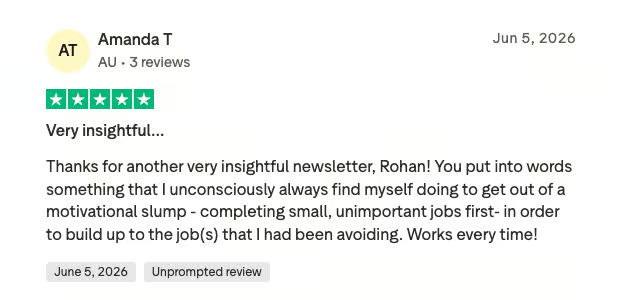
Thanks Amanda!
You can leave one here. I’d appreciate it. Thank you so much.
🤭 In all unseriousness
A few laughs to keep you smiling until next week
🤣 This is why you shouldn’t be manually writing a new cover letter from scratch for each and every application. Use something like this AI cover letter tool that writes cover letters for you - it creates a story using your background that will fit what the employers look for. And no one can tell it’s AI (unlike ChatGPT).
Try it just once for a job you actually want — see how good it is for yourself. Takes two seconds to get a great cover letter (instead of the usual 6 hours!).
If you’re working on your resume, get your resume score here. The tool will write you hiring manager-approved bullet points (unlike ChatGPT), and rewrite your existing stuff so you aren’t lying and can actually back it all up in interviews.
⚡ Try our career tools
How strong is your resume?
Find out your resume's score based on millions of real data points


Is your LinkedIn profile getting you rejected?
Our AI tool will fix yours in a couple of minutes.


If you’re new here, join at Coached.com to get the next one.