Here's a career skill that nobody talks about: being able to spot BS. Whether it's misleading data, empty promises, or carefully crafted excuses - your success depends on seeing through the noise. In today's Mentor's Corner, let's talk about why this matters and how to get better at it.
This is Coached Weekly, my career notes where I share the tiny % of ideas that actually work in real careers. It takes 5 minutes to read, but could speed up your career by years. I write this myself (no AI) and I read your replies. —Rohan Mahtani (LinkedIn)
Want to log in to Coached or see your personality assessments? Login.
The 20-second Career tactic
I've coached people for a decade. Here's one idea that moves the needle. I teach it in 20 seconds.
Clear thinking is hard in a messy room
A messy desk is low-level chaos your brain is processing whether you notice it or not. Clean it up and you'll feel the difference immediately.
I also think the standards you tolerate in your surroundings tend to leak into your work. People who let small things slide in their environment usually let small things slide in their thinking too.
Heads up:
Working on your resume or know someone who is?
Don’t forget that you can get a free resume review here.
It’ll speed up your job search (or your friend’s).

Mentor's Corner
Insights put together by me. One practical lesson a week that will make a measurable impact on your career, delivered right to you — for $0.
Why calling BS is your career's best friend
Picture this. You're an informatics expert, and a paper comes across your desk. The title:
Rooter: A Methodology for the Typical Unification of Access Points and Redundancy
The abstract begins:
==============
Many physicists would agree that, had it not been for congestion control, the evaluation of web browsers might never have occurred. [..] Our research confirms that SMPs can be made stochastic, cacheable, and interposable.
==============
You read it twice. You don't really follow it. But it's dense, technical, and sounds serious, so you assume the people who wrote it are super smart.
Then the truth comes out. You find out the paper is complete nonsense. Every line of it. In 2005, three students - before ChatGPT was a thing - built a program that generated fake papers with jargon, citations and graphs, and submitted this one to an academic conference as a prank.
It was accepted. That’s when they revealed the hoax.
Everyone, including the so-called "experts," fell for it, because it sounded smart. Not one of them stopped to ask whether it was actually true.
🧭 Why being able to spot BS is a career skill
I'm telling you this because your whole career rests on the same skill, and almost nobody works on it.
Strip a career down and it's really just a long run of decisions: which job to take, which manager to trust, whose advice to act on, which deal to sign.
You make nearly all of them based on what someone else tells you. So how well your career goes comes down, more than anything, to one question: can you tell who's giving you the truth from who only sounds like they are?
That's the skill I want to help you build. Spot the BS, and you make better calls and back the right people.
And it matters more now than ever. AI can churn out confident, expert-sounding writing on any topic in seconds, true or not. When sounding smart is free, it stops being worth anything, and the people who can still tell real from fake are the ones who get ahead.
So how do you tell the difference? Here are the checks worth running.
🧮 First principles: does it add up?
The fastest check is what people call reasoning from first principles. Ignore who's saying it and how slick it sounds, and ask whether the claim even makes sense built from the ground up.
Say someone offers you a guaranteed 30% return a year on your money if you invested with them. You don't need to know any finance, just let’s look at it from first principles:
Ask where that money would have to come from.
Warren Buffett, maybe the best investor alive, has averaged around 20% a year over his whole career.
So either this person is better than Buffett, or the returns are quietly coming from new investors' money, which is the definition of a Ponzi scheme.
The claim falls apart the second you rebuild it from scratch.
Most BS does. It's designed to pass a quick listen, not a real inspection, so it rarely survives you asking what would have to be true for it to work.
🍞 What do they get out of it?
Next, ask what the person gains if you believe them. AKA, what are their incentives?
There's a German saying: whose bread I eat, his song I sing.
People argue for what pays them. The influencer swears the product changed their life, but they're paid to say that.
The agent tells you to offer now because the market's hot, but they only get paid when you buy. It doesn't mean they're lying, just that you trust a claim less when the person profits from you believing it.
Always ask: What's their incentive? What's their expertise? What's their agenda?
🔬 Does it survive reality?
Sometimes nobody's lying. They genuinely believe what they're telling you. The information is just wrong.
Jeff Bezos was once told in a meeting that Amazon's customer response time was under a minute. The data said so. But it didn't feel right, because he’d been hearing that customers weren’t happy with support. But his team insisted the data looked good.
So he decides to verify it. He calls Amazon support in the meeting!
The actual wait was over 10 minutes.
The lesson: when the numbers and what you're hearing on the ground disagree, trust what you're hearing. The data might be measuring the wrong thing.
A statistic feels like hard proof. But someone chose what to measure and how, and that can be wrong without anyone lying. So when a number clashes with what you can see for yourself, don't back down just because it's a number. Ask how it was measured, and check it against the real world.
(It cuts both ways. When you're the one making the claim, real, specific numbers are some of the strongest backup you can bring.)
🔄 Have they done this before?
If you can't check the claim, check the person's record.
The manager who's promised that promotion "next quarter" for two years. The startup that's been "six months from profitable" the entire time you've worked there. The client who'll "definitely pay next week," every week.
People who BS tend to do it again and again. Once someone shows you the pattern, stop giving them the benefit of the doubt on anything.
👂 How does it sound?
You can also just listen. People who are bullshitting tend to share a set of tells, and once you know them, you'll hear them everywhere. None is proof on its own, since a smooth talker can fake any of them, but a few together should put you on alert.
They exaggerate. Everything is amazing, huge, the best they've seen. People who actually know tend to underplay, and since underplaying makes you sound less impressive, doing it usually means they don't need to inflate.
They stay vague. Specifics can be checked, so BS avoids them. It's why a real number on a résumé lands harder than any adjective.
They never say "I don't know." Real experts say it constantly. Ask someone something just outside their lane and watch whether they admit they don't know, or answer just as confidently as before.
They lead with credentials. People with the goods show you the goods. People without them tell you about the “Harvard course” they did.
The AI sheen. So much writing now is machine-made, and it has a texture: smooth, evenly polished, sure about everything, curious about nothing. It reads as competent because it was built to. Fluent still isn't true.
🧪 When you can't tell, test it small
Sometimes you genuinely can't verify a claim up front. Someone swears their method will transform how your team works.
So don't argue it out. Let reality answer for you: run it on something small, see if it holds, and scale it only if it does. A cheap test beats a confident opinion every time.
🏷️ Spotting it isn't enough
Everything so far helps you see the truth. Here's the part most people miss: seeing it does nothing if you can't act on it.
Watch how "there's no budget for raises this year" becomes "we found you a 40% bump" the week you show up with another offer. The BS didn't change. Your leverage did. Seeing through it was never the hard part.
So the skill has two halves. Spotting BS is the first. Calling it is the second, and calling it takes leverage: another offer in your pocket, a skill they can't easily replace, a willingness to push back instead of just nodding.
💩 Everyone's BS, including me
One last thing, and you should aim it at me too: we all BS sometimes, including me.
My advice is just what's worked for me and the people I know. I've talked to tens of thousands of people about careers, so take me seriously there. But if I start holding forth on nutrition or investing, nod politely, then go check. Being right about one thing doesn't make someone right about everything.
The best BS detector you'll ever have is your own experience. So question what you're told, test what you can, and trust what you've seen with your own eyes.
Hopefully that’s a piece of advice you haven’t heard before. If you enjoyed this:
Forward it to a friend, family member or colleague. It does truly make a difference.
If someone you know is on a job search, tell them to check out Resume Worded. It’ll make their job search a lot shorter.
Speak soon,

Rohan Mahtani
Founder at Coached & Resume Worded
Btw, I like reviews. They motivate me to keep the quality high. Like this one:
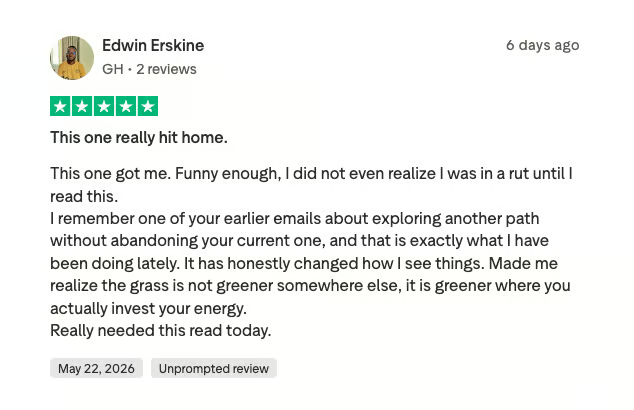
You can leave one here. I’d appreciate it. Thank you so much.
🤭 In all unseriousness
A few laughs to keep you smiling until next week
🤣 Important: it’s 2026. You shouldn’t be writing your cover letter from scratch anymore. This AI cover letter tool writes cover letters for you. And no one can tell it’s AI (unlike ChatGPT).
Try it just once for a job you actually want — see how good it is for yourself. Takes two seconds to get a great cover letter (instead of the usual 6 hours!).
If you’re working on your resume, get your resume score here. The tool will write you hiring manager-approved bullet points (unlike ChatGPT), and rewrite your existing stuff so you aren’t lying and can actually back it all up in interviews.
⚡ Try our career tools
How strong is your resume?
Find out your resume's score based on millions of real data points


Is your LinkedIn profile getting you rejected?
Our AI tool will fix yours in a couple of minutes.


If you’re new here, join at Coached.com to get the next one.