Getting stuck in a rut is one of those things everyone goes through but no one really teaches you how to deal with. In today's Mentor's Corner, I'm sharing a system I use to snap out of it — and some of the science behind why it works.
This is Coached Weekly, my career notes where I share the tiny % of ideas that actually work in real careers. It takes 5 minutes to read, but could speed up your career by years. I write this myself (no AI) and I read your replies. —Rohan Mahtani (LinkedIn)
Want to log in to Coached or see your personality assessments? Login.
The 20-second Career tactic
I've coached people for a decade. Here's one idea that moves the needle. I teach it in 20 seconds.
Make your most common emails memorable
In your career, you're gonna write hundreds of emails that people have seen before — intros, thank-yous, follow-ups. Most of these instantly get forgotten because they're generic ("Nice to meet you" or "Thank you for your time yesterday").
A good way to make yours memorable is starting with an unexpected detail or adding a tiny bit of personality. For example, instead of "Thanks for meeting yesterday," you could say, "I’m still thinking about your ‘baking bread’ analogy — perfect"
They’re what I call pattern interrupts. People will remember you for them.
Heads up:
Working on your resume or know someone who is?
Don’t forget that you can get a free resume review here.
It’ll speed up your job search (or your friend’s).

Mentor's Corner
Insights put together by me. One practical lesson a week that will make a measurable impact on your career, delivered right to you — for $0.
Feeling stuck? Here's how to get out of a rut
Do you ever feel like you're stuck on a never-ending hamster wheel?
You know the drill. Same alarm, same commute, same coffee, same small talk. You could do most of the day half-asleep, and some days you basically do.
On paper, nothing's wrong. The job's okay. The family's good. But something's off. You're bored, a little checked out, running on autopilot. Not unhappy, exactly. Just flat.
This is a rut, and the tricky thing is nothing’s actually broken. There's no obvious problem to point at and fix. It just accumulates until you feel off.
At that breaking point, people tend to reach for extreme changes. I need to quit my job! I need to move to Bali. Ah maybe a meditation retreat will solve it!
That instinct is worth listening to — something is obviously off. But blowing up your life is the desperate move, and the desperate move rarely works. Almost always, you fall into similar thought patterns somewhere new.
🧠 What a rut actually is
Science corner:
Your brain runs on a chemical called dopamine. New experiences spike it — new places, new skills, new conversations. Repeat the same day enough times and dopamine drops. You feel flat. Your brain’s just a little bored.
The reason most people's days stay so repetitive is that one version of them has been running the show too long. Maybe work-you has the loudest deadlines and the most urgent emails. Creative-you, social-you, family-you don't generate calendar invites and thus aren’t scheduled. So they never get a turn.
Often, you just stopped choosing how to spend your time and the defaults took over.
Which points at the fix. You take back the choice. You decide, on purpose, which version of you gets to run your life for a stretch, instead of leaving it to whoever happens to shout loudest.
🎭 Change your mode
Whenever I feel stuck, here’s what I do.
I pick a version of myself, name it, and commit to it for the next few weeks.
Say I notice I've been heads-down on work for months and haven't seen friends/family enough. I'll decide: for the next three weeks, I'm "Family-first Rohan."
If I’m in family-first mode and a close call comes up — work dinner vs. being home. Family wins. You've already made the decision before the decision came up.
You need to find what’s lacking most, and commit to that mode. Maybe that’s “Side-project-you” where for 3 weeks you choose your side-projects over other priorities. Or “creative you” where you focus on your creative writing efforts for 4 weeks.
One rule though: Just one mode at a time. "Social and creative and fitness and family month" is just your normal overloaded week with labels on it. Pick one. Give it a turn. The constraint is the whole point.
If this sounds strange, notice that people already do a looser version of it. Anyone who's lived somewhere with real winters knows the rhythm — winter is the hibernation mode, summer is the out-every-night mode. The season picks for them. You're doing the same thing deliberately, on a two or three week timer, instead of waiting on arbitrary weather.
A mode can be as short as a week — I use two or three week sprints. Long enough to really get out of a rut and break routine.
☕ A routine for breaking the routine
Modes are the big lever. But you don't always need a multi-week commitment — some of the rut is just too much “sameness” and not enough dopamine. You can give your brain a little bit of what it’s starving for, regularly.
The simplest version: once a week, do one ordinary thing differently. Go to a different café, take the longer route home, a meet-up you'd normally skip. Don’t make it a big deal. You're just breaking the parts of the day that have gone fully subconscious.
You can also play with timing. Love your evening walk? Switch it to the morning. Play tennis on Tuesday? Play on Thursday. Meetings monopolizing your mornings? Move them to the afternoons.
Try one small new thing each week. Make it a routine to break your routine. You’ll feel a little more energized.
🧠 See what's been on autopilot
We talked about how ruts form when you stop choosing and the defaults take over. The first step is just noticing them — catching yourself mid-autopilot and asking whether this is a choice or a leftover. That awareness alone tends to loosen a rut's grip.
If you want a shortcut to seeing those defaults laid out, our research lab built a free tool called the Career Deep Read
You give it your LinkedIn URL and in a few seconds it breaks down your career wiring — what you keep gravitating toward, what you avoid, the decisions you keep making without thinking about them.
People have found it very useful — just a heads up, it can cut deep.
And if you want to go further, the rest of Coached has tools for working through a lot of what we talked about today — figuring out direction, understanding your strengths, getting clearer on what you actually want.
Enjoy!
Hopefully that’s a piece of advice you haven’t heard before. If you enjoyed this:
Forward it to a friend, family member or colleague. It does truly make a difference.
If someone you know is on a job search, tell them to check out Resume Worded. It’ll make their job search a lot shorter.
Speak soon,

Rohan Mahtani
Founder at Coached & Resume Worded
Btw, I like reviews. They motivate me to keep the quality high. Like this one:
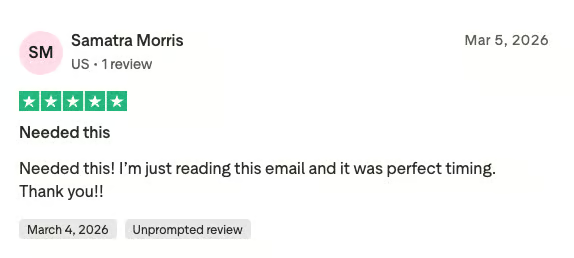
You can leave one here. I’d appreciate it. Thank you so much.
🤭 In all unseriousness
A few laughs to keep you smiling until next week
🤣 Important: it’s 2026. You shouldn’t be writing your cover letter from scratch anymore. This AI cover letter tool writes cover letters for you. And no one can tell it’s AI (unlike ChatGPT).
Try it just once for a job you actually want — see how good it is for yourself. Takes two seconds to get a great cover letter (instead of the usual 6 hours!).
If you’re working on your resume, get your resume score here. The tool will write you hiring manager-approved bullet points (unlike ChatGPT), and rewrite your existing stuff so you aren’t lying and can actually back it all up in interviews.
⚡ Try our career tools
How strong is your resume?
Find out your resume's score based on millions of real data points


Is your LinkedIn profile getting you rejected?
Our AI tool will fix yours in a couple of minutes.


If you’re new here, join at Coached.com to get the next one.