I think shyness holds more careers back than almost anything else, and most people don't realize it's happening to them. Today's Mentor's Corner is about that — with some reframes and practical stuff that helped me.
This is Coached Weekly, my career notes where I share the tiny % of ideas that actually work in real careers. It takes 5 minutes to read, but could speed up your career by years. I write this myself (no AI) and I read your replies. —Rohan Mahtani (LinkedIn)
Want to log in to Coached or see your personality assessments? Login.
The 20-second Career tactic
I've coached people for a decade. Here's one idea that moves the needle. I teach it in 20 seconds.
How to make your thank-yous better
A simple trick when sending thank-you messages professionally: always include a small, specific value-add. Instead of just saying thanks and immediately asking for another favor (which can feel transactional), mention something genuinely useful or interesting that's related to your last conversation.
For example, share a relevant article, podcast, or idea that they might actually find helpful. It takes a couple mins longer, but this is the foundation of relationships.
Heads up:
Working on your resume or know someone who is?
Don’t forget that you can get a free resume review here.
It’ll speed up your job search (or your friend’s).

Mentor's Corner
Insights put together by me. One practical lesson a week that will make a measurable impact on your career, delivered right to you — for $0.
Is shyness strangling your career?
There's a version of you that only shows up in certain rooms — the version with close friends and family, that just says what it thinks. And there's another version, in rooms with people you've decided matter more, that goes quiet.
The gap between those two versions is shyness. It's why competent people get passed over at work for louder, weaker colleagues. And it's why the people you most wanted to know rarely end up knowing you.
The strange part: Most people with this problem don't call it being shy. They've got better names for it — names that make them feel good about the thing that's holding them back.
Which is exactly the problem.
🎭 The disguises
If you'd asked me a few years ago whether I was shy, I'd have said no.
I'd have conveniently said I was introverted. That I let my work speak for itself.
Both true. Both also giving me cover.
The cover for shyness usually comes in one of three phrases:
"I'm introverted.": After not introducing yourself to someone you want to meet, you say I’m just introverted. But introversion is about where you get your energy. Shyness is the fear of being judged. You can be the first without being the second — plenty of introverts speak up and ask for what they want. They just want a quiet evening afterward.
"I'm being respectful." If you don’t shoot your shot with someone in your industry, the cover is I was being respectful. Sometimes true. But you can still be respectful by being direct and giving people an easy out.
"I'm humble, I don't like to brag." When someone praises your work and you brush it off, or you finish something good and don’t take credit or make it known, the cover is I'm humble. But humble people can still own what they've done — they just don't oversell it. The likely truth is it’s just shyness and discomfort with being seen.
🪞 The root of the problem
You're not shy around your family or best friends. With them, you speak your mind.
So shyness isn't part of who you are. Specific people and situations trigger it - like if you’re in a room where there are senior/impressive people - and the stakes feel high.
In those situations, you might refrain from speaking up because you’re nervous/shy. But those situations are the exact ones where there’s a lot to gain:
If you suggest a good idea in a room full of C-suite execs, one might remember you and ask you to join a high visibility project.
The people you're nervous around are the ones you likely want to know. Speaking up is how you fix that!
A reframe that’s helpful is recognizing that a lot of ‘high-stakes’ situations are not ‘high-stakes’ at all. Is asking a question or sharing your view really that high-stakes? Everyone will forget about it a day later.
🏋️ Overcoming shyness = bias for action
Shyness behaves like a fitness level. After a stretch of barely speaking to anyone, the next dinner with strangers feels heavy — but do a few dinners, and it gets light again. The way through is doing more of what makes you shy.
Once you practice your courage muscle, it feels more natural to start conversations, ask a question in a room full of people — and to get good at it.
So, start with low-stakes situations. Where the stakes are basically zero:
When ordering coffee, ask the barista how their day is going before ordering
Make a brief comment to someone in the elevator
Try your ideas out on friends before bringing them into bigger rooms
Then, start getting comfortable in slightly more uncomfortable situations:
Post something you're thinking about on LinkedIn — sharing your ideas publicly is a good way to practice that muscle.
Send a thoughtful email or Slack message to someone senior with your take on something — if speaking up feels hard, writing is still putting yourself out there
Ask for that job referral, etc.
Also keep in mind that shyness has a half-life. The longer you go without doing the brave thing, the bigger it grows in your head. This is why I always say: when you show up somewhere new — an event, a dinner, a conference — say hi to someone immediately. If you wait an hour, it feels infinitely more awkward. Acting fast keeps the fear from calcifying in your head.
🎤 Preparation beats shyness
One last thing that helps: preparation. A lot of shyness comes from not knowing how something will go — and preparation takes most of that uncertainty away.
This is why I always recommend having an intro ready (often called an elevator pitch). When you see someone you'd love to meet, it’s hard to initiate — what do you even say? A good pitch fixes that. You introduce yourself with a sharp line about what you do, you come across as impressive and someone worth knowing, and things flow.
So our research lab built a free tool to help you nail it.
It's called the Coached Elevator Pitch. It reads your LinkedIn, finds the gold, tells you what to lead with + how to sound impressive to everyone you meet.
And if you want to go deeper from there, the rest of Coached has tools for working through a lot of what we've talked about today — figuring out direction, understanding your strengths, getting clearer on what fulfillment actually looks like for you specifically.
Enjoy!
Hopefully that’s a piece of advice you haven’t heard before. If you enjoyed this:
Forward it to a friend, family member or colleague. It does truly make a difference.
If someone you know is on a job search, tell them to check out Resume Worded. It’ll make their job search a lot shorter.
Speak soon,

Rohan Mahtani
Founder at Coached & Resume Worded
Btw, I like reviews. They motivate me to keep the quality high. Like this one:
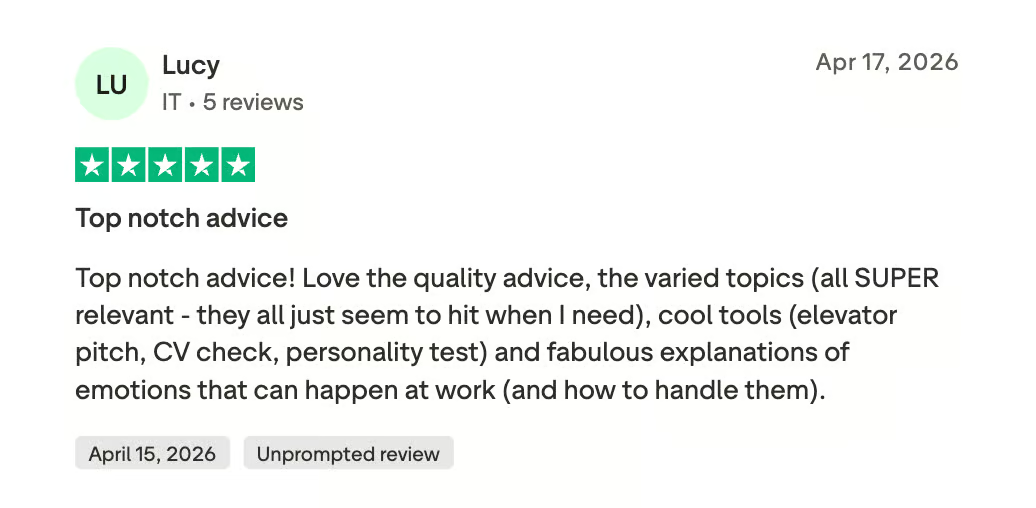
You can leave one here. I’d appreciate it. Thank you so much.
🤭 In all unseriousness
A few laughs to keep you smiling until next week
🤣 Important: it’s 2026. You shouldn’t be writing your cover letter from scratch anymore. This AI cover letter tool writes cover letters for you. And no one can tell it’s AI (unlike ChatGPT).
Try it just once for a job you actually want — see how good it is for yourself. Takes two seconds to get a great cover letter (instead of the usual 6 hours!).
(a story from kevin hart that’s very relevant to the mentor’s corner topic - link, 2 min video)
If you’re working on your resume, get your resume score here. The tool will write you hiring manager-approved bullet points (unlike ChatGPT).
⚡ Try our career tools
How strong is your resume?
Find out your resume's score based on millions of real data points


Is your LinkedIn profile getting you rejected?
Our AI tool will fix yours in a couple of minutes.


If you’re new here, join at Coached.com to get the next one.