
Most people's strategy for getting promoted is: do great work and hope someone notices. Today's Mentor's Corner is about why that doesn't work, and what to do instead — with some specific tactics and scripts you can start using this week.
This is Coached Weekly, my career notes where I share the tiny % of ideas that actually work in real careers. It takes 5 minutes to read, but could speed up your career by years. I write this myself (no AI) and I read your replies. —Rohan Mahtani (LinkedIn)
Want to log in to Coached or see your personality assessments? Login.
The 20-second Career tactic
I've coached people for a decade. Here's one idea that moves the needle. I teach it in 20 seconds.
End meetings 5 minutes early
If a meeting's scheduled for 30 minutes but everything's covered in 20 — end it. Don't fill the remaining time just because the calendar says so. A lot of people treat scheduled time like it has to be used up, so they start pulling in loosely related topics or rehashing things that are already decided. Finishing early shows you know what the meeting was actually for — to make decisions. Your colleagues will quietly love you for it.
(Just don't say "I'm giving you 15 minutes back" when you do — that cringe phrase needs to be retired. It was never yours to give.)
Heads up:
Working on your resume or know someone who is?
Don’t forget that you can get a free resume review here.
It’ll speed up your job search (or your friend’s).

Mentor's Corner
Insights put together by me. One practical lesson a week that will make a measurable impact on your career, delivered right to you — for $0.
The career habit that leads to promotions
In Saving Private Ryan, Captain Miller (Tom Hanks) leads a squad on a dangerous mission to find and rescue one soldier. His men are all complaining about it — risking all their lives to save one guy.
One of them, Reiben, asks their boss who’s sitting quietly: "So Captain, don't you complain at all?"
Captain Miller replies: "I don't complain to you, Reiben. There's a chain of command. Complaints go up, not down. Always up. You complain to me, I complain to my superior officer, so on and so on. I don't complain to you. Nor do I complain in front of you."
Reiben pushes: "Okay, but let's say you weren't a Captain and I was your superior. What would you say then?"
He replies deadpan: "Well in that case, I'd say this is an excellent mission, Sir, with an extremely valuable objective, Sir, worthy of my best efforts, Sir. Moreover, I feel grief for Private Ryan’s mother, and I'm willing to lose some lives — especially yours, Reiben — to ease her suffering."
The men laugh. "He's good."
Great scene. But there's a career lesson buried in it that most people get backwards.
🔇 Your work doesn't speak for itself
Most people aren't deliberate about this at all. They put their head down, do good work, and assume the right people will notice. And when they do go up the chain, it's because they've hit a problem they can't solve.
But think about what that looks like from your manager's side. They're busy. They're not tracking your day-to-day so they don’t know what you’ve done. Worse, the only time your name shows up is when something's gone wrong. Over time, you subconsciously become — in their mind — the person who brings problems. You could be solving ten problems a week, but they don’t associate you with that because they’re unaware.
What you want is the opposite reputation: the person who “gets things done”. When people associate you with that, you get pulled into projects, considered for roles, recommended in rooms you're not in. That reputation is one of the most valuable things you can build, and it doesn't happen by accident.
🎯 Strategic escalation
So how do you build that reputation? By going up the chain not when you have a problem, but when you've solved one. I call this strategic escalation. If there's one career habit that directly leads to promotions and raises, it's this one.
Say a supplier tells you there's going to be delays that could impact next month's project. Most people would flag this to their boss — "hey, we might have a problem." Instead, contact another supplier, sort it out, and then send this:
✅ Subject: short logistics update
Just a heads up:
Ken from Lightning Logistics told us they're experiencing delays, which might impact our delivery schedule for next month's project.
Long story short: I've contacted another supplier and they'll be able to pick up the slack, so we're good to go. I'll keep you posted if anything changes.
Same situation. But your boss just saw you handle it, not report it.
There are probably hiccups you run into at work that you resolve. Instead of just handling them, make note of them and surface them consistently.
📡 Other ways to do this
The supplier email is one example, but you can make this a habit in smaller ways too.
Email updates: If you're on an important project, ask your boss if they'd like a brief weekly update. Not a report — just a pulse: "Quick update on [project]: hit a snag with [X], resolved it by [Y]. On track for [deadline]. Let me know if you want more detail."
1-1s work too. Most people use them to talk about blockers. Try opening with something you handled well first. "Before we get into the agenda — wanted to flag that we closed out [X] ahead of schedule" changes the tone of the whole meeting.
Do it in writing when you can. The secondary benefit is you're building a log. When it's time to make your case for a promotion, prep a review, or update your resume (Resume Worded is awesome for that — get a free resume review), you'll have months of examples ready.
Introduce AI to your team. If you've figured out how to use AI tools to speed up your work, share that with your team and your seniors. Most orgs know they should be using AI but don't know where to start. If you’re that person, you’re super visible and indispensable. It's a hot topic right now and people lean in.
After a win that involved other teams: "Wanted to close the loop on [project] — we hit [result]. Thanks to [person] for [their contribution]." (Giving others credit in an update to your seniors is one of the least braggy ways to make your own work visible.)
🧭 Don't be annoying
One caveat: escalate constructively, not loudly.
There's a line between keeping people informed and performing for them. You'll feel it — if every update starts to feel like bragging, it probably is.
But the bigger mistake is the opposite: doing great work and assuming it speaks for itself. The work you don't make visible is, for career purposes, work you didn't do!
I know it sucks to play corporate politics. But here’s a reframe - it’s not, really. It's just good communication. The best people I've worked with do this naturally — they close the loop, they keep people informed, they surface what they've learned. It’s just doing the job well and once you make it a habit, it stops feeling like politics and just becomes how you work.
Hopefully that’s a piece of advice you haven’t heard before. If you enjoyed this:
Forward it to a friend, family member or colleague. It does truly make a difference.
If someone you know is on a job search, tell them to check out Resume Worded. It’ll make their job search a lot shorter.
Speak soon,

Rohan Mahtani
Founder at Coached & Resume Worded
Btw, I like reviews. They motivate me to keep the quality high. Like this one:
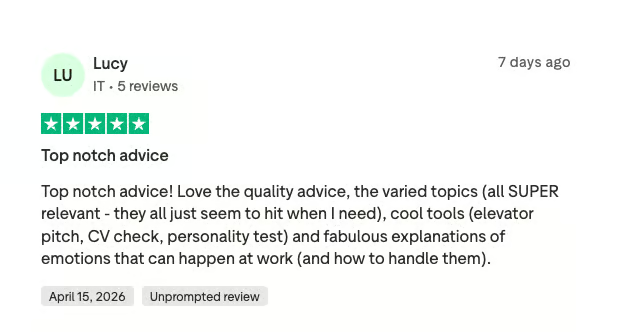
Thank you Lucy!
You can leave one here. I’d appreciate it. Thank you so much.
🤭 In all unseriousness
A few laughs to keep you smiling until next week
🤣 Important: it’s 2026. You shouldn’t be writing your cover letter from scratch anymore. This AI cover letter tool writes cover letters from scratch. And no one can tell it’s AI (unlike ChatGPT).
Try it just once for a job you actually want — see how good it is for yourself. Takes two seconds to get a great cover letter (instead of the usual 6 hours!).
⚡ Try our career tools
How strong is your resume?
Find out your resume's score based on millions of real data points


Is your LinkedIn profile getting you rejected?
Our AI tool will fix yours in a couple of minutes.


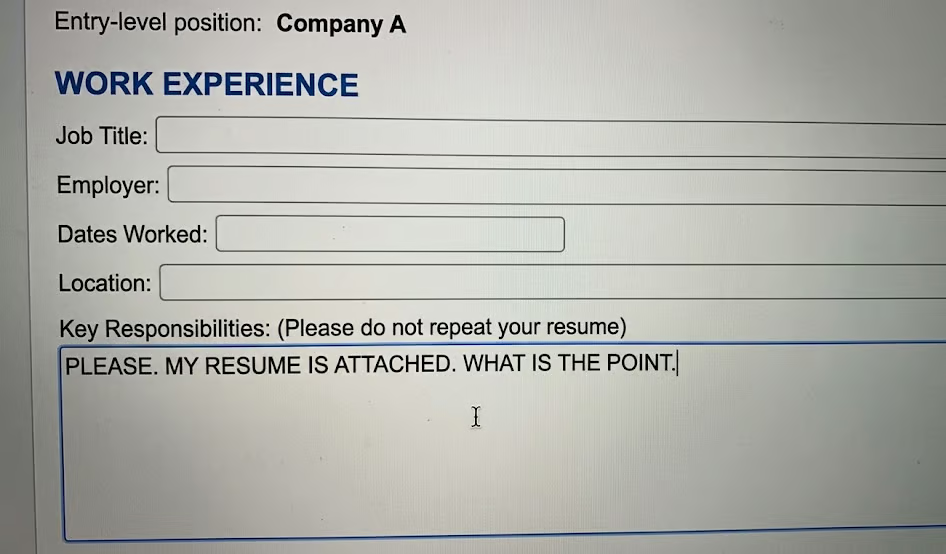
If you’re working on your resume, get your resume score here. The tool will write you hiring manager-approved bullet points (unlike ChatGPT).
If you’re new here, join at Coached.com to get the next one.