This week’s Mentor’s Corner is about one of the easiest, smallest ways to leave a lasting impression — and almost nobody gets it right.
This is Coached Weekly, my career notes where I share the tiny % of ideas that actually work in real careers. It takes 5 minutes to read, but could speed up your career by years. I write this myself and I read your replies. —Rohan Mahtani (LinkedIn).
The 20-second Career tactic
I've coached people for a decade. Here's one idea that moves the needle. I teach it in 20 seconds.
Don't just flag problems, suggest a fix
When you run into an issue at work, don’t just tell your manager or team "Hey, this broke, what should I do?" Instead, always pair the problem with a suggested solution ("Here's what's broken, and here's how I think we can handle it").
This helps in two ways: you won't get branded as "the problem person," and it actively trains your decision-making skills. Managers notice and love this — it's exactly what they look for when deciding promotions because it shows you take ownership.
Heads up:
Working on your resume or know someone who is?
Don’t forget that you can get a free resume review here.
It’ll speed up your job search.

Mentor's Corner
Insights put together by me. One practical lesson a week that will make a measurable impact on your career, delivered right to you — for $0.
The career mistake of not saying "thanks" (+ how to do it right)
One of the most unexpectedly powerful scenes I've watched in a movie is from the final part of the Lord of the Rings trilogy.
Quick context if you're not a LOTR nerd:
The story ends with Aragorn, the hero, finally becoming king. At his coronation, everyone bows. When four humble hobbits — the story’s smallest, most overlooked heroes — start to bow, Aragorn stops them immediately and says: “My friends, you bow to no one.”
Instead, he — as the new king — bows to them, and everyone else follows.
Nothing “sad” happens. But when the music score hits, and it’s almost impossible not to feel a wave of emotion.
But why?
One word: Gratitude.
At his most triumphant, Aragorn passes the spotlight over to the hobbits as a genuine thanks. Which brings me out of Middle Earth to your career:
If gratitude can feel this strong…
Are you showing it in your career to the people who’ve helped you?
Or are you strangling your career with ingratitude, cutting off the branches of goodwill people have offered you?
It’s an important, yet rarely discussed topic, so today I’m going to share a few ways to say “thank you” in your career.
Here we go.
🙏 Be genuine.
This is why the LOTR scene lands - Aragorn is completely genuine. You must do the same. Remember, people can detect insincerity a mile away.
Gratitude also resonates more when it's unexpected — especially if you're recognizing someone who might not realize how helpful they’ve been.
🗝️ Be specific
If you just say ‘Thank you’, it can come across as insincere or a hollow comment. Because, what are you thanking them for?
So, be specific. It’s more memorable and feels more real.
Weak: "Thank you for the help!"
Strong: "The advice you gave me on how to be more assertive at work really struck home. It made me realize where I'm being too passive and helped me take charge during our last team meeting. Thank you!"
By the way, if you’re a manager, be specific when giving compliments to your employees too:
"Carlos, your insights on the Phoenix campaign were spot-on. Thanks for steering us in the right direction."
🤖 In the age of AI, sincerity matters even more
ChatGPT makes it effortless to generate thank-you notes, emails, or even LinkedIn messages. They’re super easy to spot - there’s a certain emptiness to them and they’re oddly fake. Take these two examples:
Option A: “Thank you for your insightful point about ABC. It really helped clarify the topic and added a valuable perspective to the discussion.”
Option B: "Oh man, that point you made on ABC topic was AWESOME. I love your brain!"
Sure, option A is more ‘proper’. But yeah, it’s ChatGPT. What are the clues? It feels templated, uses buzzwords, overly fluffy, and doesn’t feel real. Option B took me a second to write, it’s weird — who says “I love your brain”? But that’s precisely why I like stuff like it → it stands out + it’s a pattern interrupt.
Do not send generic AI thank yous (or, at least prompt your AI better!). Don’t say thanks because you have to, do it because you want to. That brings me to my next point…
🔄 Don’t expect (or hope for) anything in return
Hot take:
Most people only say ‘thank you’ in their careers because they expect something in return. And there lies the problem - people can always see you circling back.
Here’s the mindset we want to adopt instead:
You’re not trying to get something. You’re trying to show something.
It’s a small mental shift, but it makes a difference in how you come across.
Obviously, expressing genuine appreciation has its own positive impact on your relationships (it strengthens them!). When you show appreciation without expecting anything in return, people will be more likely to want to help you again in the future. But remember — that's just a side effect, not the main goal.
⚡ Late is infinitely better than never
We often hesitate to say thanks because it feels awkward after a long time. But a delayed thank-you often means more, because you've had time to truly realize how much someone’s help impacted you.
A reader sent me this some time ago (thanks Liz!):
"Take the trouble to thank people, however long after the event. I recently had a fantastic email 20 years after providing guidance. The author of it explained how beneficial my work had been throughout her career. What an email!"
If you think it's too late, it's not. Just send it.
🎯 Keep the thank you appropriate
This is a mistake a lot of people make. You've got to match the level of your thank you to the help you received. Avoid overly dramatic thank-yous unless you mean it. And avoid casual 'thank yous' for something that someone went out of their way to help you with (that’s dismissive).
I once had a boss who would often say, "Rohan, you're an absolute superstar," for mundane tasks like forwarding an email. He meant well, but soon his compliments lost all meaning — even when they were genuine.
For example:
Too much: "I can't thank you enough for proofreading my report! I'll never forget your kindness. What would I do without you!"
Good: "Appreciate you proofreading—needed fresh eyes. Thanks!"
That being said, if someone has literally changed your life, tell them they did and don't tone it down. The point is to be genuine.
🏆 Shine a light (Public thanks)
Private thanks matter, but publicly recognizing someone builds their reputation (and yours). At work, make it a habit to highlight others publicly:
Mention someone’s accomplishment in front of the team.
Tag them in a LinkedIn post about a project win.
Post a shout-out on Slack or in a group email. e.g. "Jon, great stuff on that market analysis you did - it's what made the campaign work! Probably saved us weeks."
Don’t be artificial about it though. You're not trying to put on a show.
I'll end this piece with a challenge (should you choose to accept it)!
Who has made an impact on your career? Your parents? A sibling? A mentor? A teacher? A friend? Someone you follow online?
Write them a short note to say a specific 'thank you'. By email, LinkedIn, text, pen & paper — it doesn't matter what you use.
It'll probably be the first truly genuine thanks they've received in ages. And I promise they'll remember it.
Hopefully that’s a piece of advice you haven’t heard before. If you enjoyed this:
Forward it to a friend, family member or colleague. It does truly make a difference.
If someone you know is on a job search, tell them to check out Resume Worded. It’ll make their job search a lot shorter.
Speak soon,

Rohan Mahtani
Founder at Coached & Resume Worded
Btw, I like reviews. They motivate me to keep the quality high. Like this recent one:
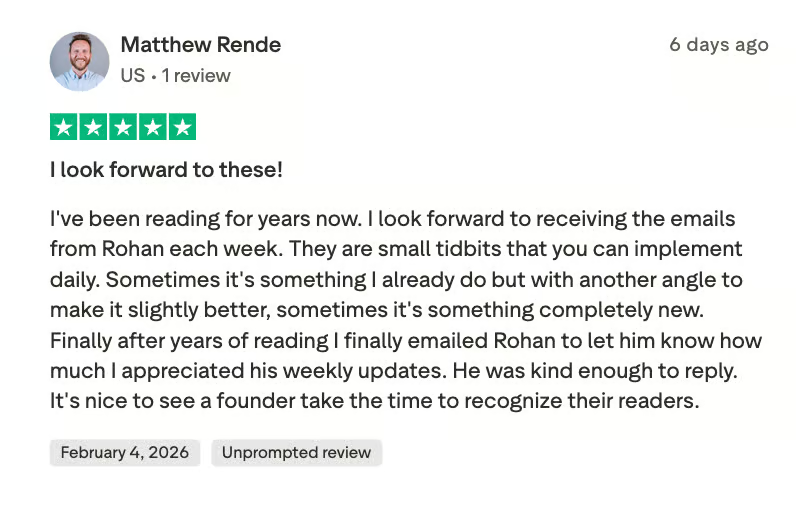
Thank you so much, Matthew! <3
You can leave one here. I’d appreciate it. Thank you so much.
🤭 In all unseriousness
A few laughs to keep you smiling until next week
🤣 In 2026, you don’t need to write cover letters anymore — if you have the right tools. This AI cover letter tool is really good. It’ll write entire ready-to-go cover letters that actually have personality (the best part: unlike ChatGPT, it writes letters that are engaging and don’t sound like AI).
Try it just once for a job you actually want — see how good it is for yourself.
⚡ Try our career tools
How strong is your resume?
Find out your resume's score based on millions of real data points


Is your LinkedIn profile getting you rejected?
Our AI tool will fix yours in a couple of minutes.


If you’re new here, join at Coached.com to get the next one. If you want the web version, it’s at the top of my list of essays here.