
Good morning Coached readers! It's Rohan with Coached, your personal mentorship email that takes a few minutes to read, but contains stuff that will speed up your career by years.
Today's Mentor's Corner comes from an unexpected place: stand-up comedy. I know — "wtf does that have to do with my career?" That's what I'd think too. But after watching comedians work (and trying it myself!), I realized they're masters at skills we need professionally: getting to the point quickly, reading a room, and making genuine connections with strangers. I'll share what I’ve learned that you can steal for your own career.
If you haven’t tried this yet, you really should: We built this 15-minute test that shows you things about yourself you can't see — like why certain jobs drain you while others energize you, or what invisible patterns shape every career decision you make. Created with PhDs, usually costs $50-100 elsewhere, but free for Coached readers.
People who've taken it keep saying things like "this explained everything" and "I wish I had this years ago." It'll genuinely help you make better career moves. Takes less time than your commute (unless you work from home). Try the Coached Impact Assessment now.
Estimated read time: 5 minutes 14 seconds
Want a faster job search?
Fix your resume.


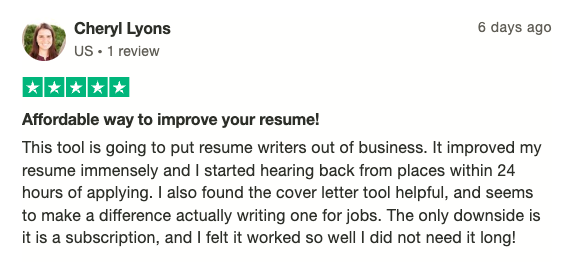
Real results:
📈 Mentor's Corner
Insights put together by me. One practical lesson a week that will make a measurable impact on your career, delivered right to you — for $0.
The communication secrets comedians use that work in any room
Ever since watching my first Chris Rock special, Bring the Pain, I’ve been a huge stand-up comedy fan.
On the one hand, it’s a great form of entertainment. But also, I reckon it benefits my career too: after a long stressful week, laughter is the ultimate therapy.
That said…
While I’ve enjoyed it from the side-lines, the prospect of actually doing stand-up comedy was terrifying.
(If public speaking is scarier than death, what does that say about public joke-telling?)
And that’s when I realized…
If I was so scared of it, that meant only one thing:
I HAD to try it.
So that’s why, on a cold Thursday night in August last year, your ‘ol buddy Rohan trudged nervously into a hall for the first session in a 3 month block of a stand-up comedy course.
I’m not gonna lie…
Before most sessions… I was nervous.
Like, really nervous.
But by the end of the 3-months, it turned out to be an amazing experience. And what’s more, it also taught me some very valuable “nuggets” for our careers too.
And that’s what I want to share with you in today’s issue of Coached.
Let’s go.
Before we dig in… PSA
Want to get ahead? Follow my career advice on LinkedIn.
I write short actionable stuff through the week. Stuff that will truly benefit your career in measurable ways: strategies you can steal, email scripts you can copy/paste, AI prompts for your career, etc. And I’m constantly replying to your questions there in the comments.
Join the 32k people who've already gotten ahead using these tactics — See you there.
alright, let’s get back to my essay…
🌪️ Get to the point. Quick!
All jokes are made up of two parts: a set-up, and a punchline. The set-up is what ‘sets up’ the joke, the punchline is when the audience laughs.
For example, a Steve Martin classic:
Set-up: I like a woman with a head on her shoulders.
Punchline: I hate necks.
(Notice how the set-up’s important. Just saying ‘I hate necks’ isn’t funny on its own. Even though it’s the part that makes people laugh.)
Now, here’s the thing to remember:
The goal of standup is to be as concise as possible with the set-up.
Because people’s attention spans are so low nowadays, if you start rambling, they’ll drift off and get lost for the punchline.
🗃️ A tale of two jokes
To show you what I mean, here’s two versions of a joke I just wrote off the top of my head.
(I know it’s pretty lame - I tried to come up with something career-related to stress my point!)
Version A:
Set-up: "After a week filled with back-to-back meetings, I finally mustered up the courage to tell my boss that I was feeling completely overwhelmed with meetings and could really use some guidance on how to manage my time better..."
Punchline: "He sent me a calendar invite for a 'Time Management' workshop"
Version B:
Setup: I told my boss I was feeling overwhelmed with meetings.
Punchline: He sent me a calendar invite for a 'Time Management' workshop.
(ba-dum-tshh)
Notice how the joke’s equally funny (if not more so) with a shorter setup. With the long setup, the unnecessary details just water it down.
Now…
What does this have to do with your career?
Well, short “set-ups” are just as important in the professional world, too.
Which leads me to my next point:
✂️ Trim the fat!
To be as efficient as possible with the “set-up”, you have to be as ruthless as possible about trimming the fat.
=> whenever we’re writing an email, or designing a presentation, ask yourself:
“Is this word / sentence / paragraph necessary?”
If the answer’s “no,” cut it!
Here’s a simple example of what I mean. I’ve trimmed the ‘fat’ with the struck out text:
Hi Sarah,
I hope this email finds you well. I wanted to touch base with you regardingCan we discuss the Q3 marketing budgetthat we briefly mentioned in last week's meeting?I think it would be beneficial for us toLet's schedule aquick30-minute callto go over the details and ensure we're aligned on our priorities!Please let me know your availability for the coming week, and I'll set up a calendar invite accordingly.
I’m available Tuesday, 2-4 PM and Thursday, 10-11 AM.
The trimmed email looks like this:
Hi Sarah,
Can we discuss the Q3 marketing budget? Let's schedule a 30-minute call!
I’m available Tuesday, 2-4 PM and Thursday, 10-11 AM.
I over-trimmed stuff to make my point. The earlier you are in your career, you need a couple more niceties, but drop them as you become more senior.
⏱️ Master the elevator pitch
Comics often need to explain their style in just a few seconds to land gigs. It's like the world's shortest, high-stakes elevator pitch.
In your career, you need this skill too. Can you summarize your project, your role, or even your entire career in 30 seconds?
Practice this. It'll come in handy more often than you'd think – whether you're networking, interviewing, or pitching ideas to senior leadership.
Your LinkedIn profile works the same way - it's essentially your written elevator pitch that needs to grab attention in the first few seconds.
Speaking of LinkedIn
I kept seeing friends get zero opportunities simply because their profiles failed the elevator pitch test - they didn't hook anyone in those crucial first few lines.
We built a free LinkedIn optimization tool that shows you exactly how to reframe your experience and what to fix. Takes 30 seconds:
👣 Have your go-to moves ready
Watch any comedian do a set or interact with the audience and it looks effortless. They seem to naturally connect with strangers, making witty observations about people's jobs or relationships on the spot.
But here's the secret: most of it IS NOT improvised.
Experienced comedians have practiced crowd work routines. They know which questions reliably get interesting responses. They have backup lines ready when someone gives a boring answer. What looks spontaneous is actually carefully rehearsed.
The same principle applies to building professional relationships.
Instead of defaulting to talking about the weather, develop a few conversation moves that actually work in real situations. Some rough ideas:
At work events: "This place is way fancier than I expected" or "Did you get stuck in that traffic mess outside?"
With new colleagues: "Have you found a favorite food spot around here yet?" or "What's surprised you most about working here?"
Industry events: "Are you presenting or just here to learn?" or "Any sessions you're looking forward to?"
A good pattern: start with an observation (or a strong opinion, like “I LOVE X about this, or “I HATE Y here!”) about the shared situation you're both in, then transition to something that gets them talking about their actual experience.
🌀 Catch the rambler
One area I really sharpened after I hung up my standup hat — a distinguished career, I know ;) — was my speaking.
Specifically, I started rambling less during conversation. I became much better at catching myself going off on a tangent, and getting back on topic.
So my advice?
Try to catch yourself when you start to ramble, too.
Especially in meetings. Chances are, your ramblings are far less interesting to the team than they are to you.
And, that’s a wrap!
If you enjoyed this essay, all I’d like in return is one small favor.
(I don’t ask you for a lot….rather, these emails are expensive to send out, yet I keep them free and don’t paywall the best parts). Just do any of these - it really helps!
1. Know someone on a job search? Tell them about Resume Worded.
It’ll make their job search a lot shorter. They can get a free resume review at resumeworded.com/free-resume-review
2. Got a smart friend who LOVES getting better? Tell them about Coached.
I love seeing them reach people who want more out of their careers. If you want to share this essay with a friend, or colleague, here’s a link to it: https://coached.com/essays/what-i-stole-from-stand-up-comics/- I promise to keep the quality of my emails high so they love you for it.
3. Leave a quick review for Coached.
You get ideas that change your career for the better. In return, a short 30-second review would make me feel good about spending the time to write this. I think it’s a fair trade. Do it here.

📌 Tool spotlight
A spotlight on a really useful feature in Resume Worded
This is what 90% of resume bullets look like:
- Managed social media accounts and increased engagement
- Led a team of people to complete projects on time
- Responsible for analyzing data and creating reports
× Vague. Forgettable. Says nothing about what you actually did.
Your resume might have bullet points like this — and if it does, it’s one reason your resume might not be taking you far.
The thing is, you've achieved way more than what these bullets show. You just need to punch them up.
One way to do that is with our AI. Here’s how it rewrote the above bullets:
- Managed company Instagram and LinkedIn accounts, growing follower base from 2,000 to 3,500 through consistent posting schedule and engaging with industry content
- Led team of 5 junior analysts to complete quarterly reporting 3 days before deadline, allowing senior leadership extra time for strategic planning
- Analyzed weekly sales data in Excel to identify 8 top-performing products, creating monthly reports that helped managers adjust inventory levels
✔ The same work. Just written like recruiters want to see it.
Notice how these bullets actually show impact. Hiring managers see bullets like this and think "I need to interview this person."
You likely HAVE these details and numbers somewhere. You just don't know how to frame them — which is totally normal for people unfamiliar with resume writing.
To fix that:
Upload your resume here and use the AI — it'll rewrite your bullets to actually show what you did. Takes seconds. Might actually get you interviews.
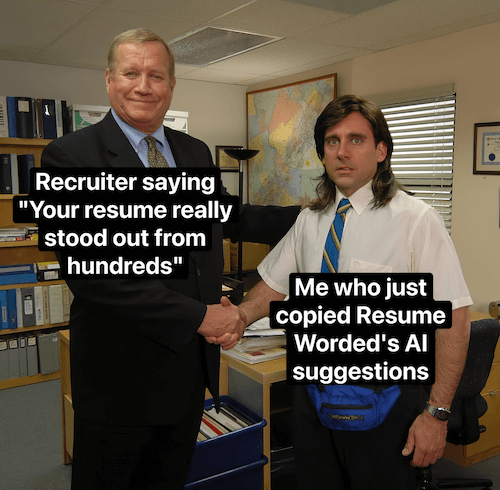
🤭 In all unseriousness
🤣 …but real talk: For a real, *actually good* cover letter, use this AI cover letter tool. It’ll write cover letters that does NOT use overused clichés like the above and don’t sound like AI — unlike ChatGPT. Try it just once for a job you actually want — see how good it is for yourself.
🔎 Speed Up Your Job Search
One actionable piece of advice to help you hack your job search.
How to use the STAR method on your resume
You might have come across the STAR method, which stands for Situation, Task, Action, Result. It's usually known as an effective framework for answering interview questions.
But it's also effective to use when writing your resume. I'll break down what it means, as well as give you an example of how to use it in practice.
First, here's what STAR stands for...
Situation: What was the context of the problem?
Task: What was the task that needed to be solved?
Action: What exactly did you do?
Result: What was the outcome?
When writing your resume's bullet points, you should aim to touch on as many as you can. It's clearer with a real example:
Designed an email toolkit and style guide to enable teams to quickly build mobile-responsive emails and maintain visual consistency; led to time savings of 5+ hours per week
Let's break down how it uses the STAR approach:
Situation/Task: Enable teams need to build responsive emails.
Action: Created design components like a toolkit.
Result: Saved time!
Because bullet points need to be concise, the situation and task, or the action and result, might both be the same thing.
🎯 You should use a tool like Score My Resume to find out if your resume is effective enough. It'll analyze each line on your resume, plus the Magic Write feature will write bullet points for you that use the STAR method.
It’ll also give you ideas on how to quantify your bullet points, even if you haven't worked in a sales role or don't have access to numbers.
Stop applying to jobs with a bad resume!
Optimize it once for free.
🫵 Before we wrap up
What'd you think of today's edition?
🤢 You didn't bring enough value.
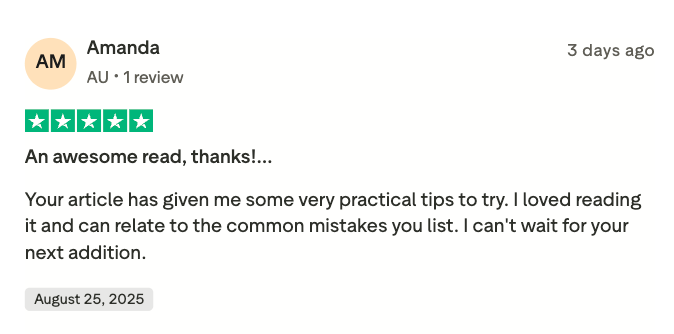
Here are some reviews of my last email. Leave one here. You’ll be in good company :-)
If you missed it last week, see it here.
And if you’re new here, join at Coached.com to get the next one
Until next time,

Rohan
Founder at Coached & Resume Worded