|
There's a quiet anxiety many of us feel as we get older - that maybe our window for career growth is closing. But what if everything we've been told about career timelines is backwards? In today's Mentor's Corner, I'm exploring why your most successful career chapter might actually be the one you haven't written yet. |
Before we begin... from our research team. |
• Learn more about yourself in 15 minutes than most people do in years. • Try our free personality test. Backed by decades of research. • "I sent this to my whole team" — we hear this a lot. Take the test → • Already done it? Add your partner, friend or coworker — see why you click. |
|
This is Coached Weekly, my career notes where I share the tiny % of ideas that actually work in real careers. It takes 5 minutes to read, but could speed up your career by years. I write this myself and I read your replies. —Rohan Mahtani (LinkedIn). |
The 20-second Career tactic I've coached people for a decade. Here's one idea that moves the needle. I teach it in 20 seconds. |
The hidden cost of looking unapproachable |
I think something people rarely think about — but should — is whether they’re easy to approach at work. Opportunities often start casually, like someone inviting you to something or asking your input on a quick question. But if you accidentally look stressed or serious (we all do this!), people might hesitate: "Oh, you looked busy," or "You seemed annoyed." |
Small stuff like having a warmer resting face, turning around with a smile instead of a flat "what?", or avoiding crossed arms in meetings sounds trivial, but actually has compounding effects. |
|
|
| | | | Heads up: | Working on your resume or know someone who is? | Don’t forget that you can get a free resume review here. | It’ll speed up your job search (or your friend’s). |
| |
| | |
|
|
Insights put together by me. One practical lesson a week that will make a measurable impact on your career, delivered right to you — for $0. |
Why your "career prime" might still be ahead of you |
To use the Family Guy line, you know what really grinds my gears? |
The silent dread many of us feel when we hit our late 30s, 40s, or 50s — that creeping thought that maybe our best career moves are behind us. |
I see this everywhere: people settling into roles they've outgrown or stop pursuing things because "it's too late." |
But this idea that careers peak early is flat-out wrong. Take these examples: |
Colonel Sanders got into a fistfight with a client in his own courtroom, failed as a lawyer, and didn't start KFC until 62. Fashion designer Vera Wang was a figure skater, then a journalist for 16 years, and didn't design her first dress until 40. Christoph Waltz spent decades doing German-language TV nobody outside Europe watched, then won an Oscar at 53.
|
Napoleon Hill put it well in Think & Grow Rich: |
"Those who succeed in an outstanding way seldom do so before the age of 40. More often, they do not strike their real pace until they are well beyond the age of 50." |
These aren't flukes. There are structural reasons why careers get more powerful with age, not less. Which is why you should think the opposite: the best years of our careers are still to come. |
Here's why I believe that. |
🕸️ Your network compounds |
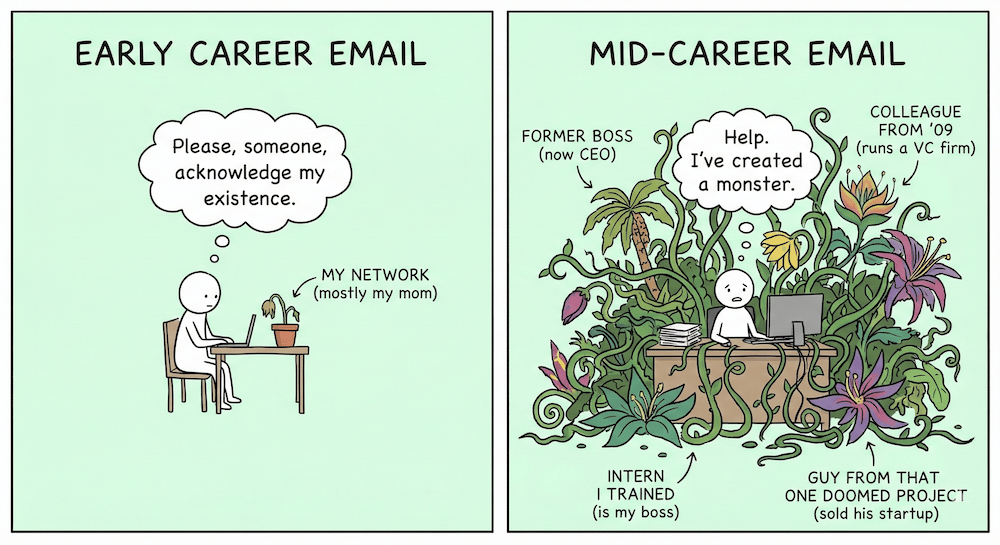
Early in your career, you're reaching out to people who have no reason to help you. By your 40s, that's reversed. You've spent two decades working alongside people — on projects, in teams, through difficult stretches — and those relationships are worth more than most people realize. |
Partly because there are more of them than you think. It's not just former bosses or close colleagues. It's everyone you've ever done real work with. And partly because those people have also been advancing. The network you have at 45 is compounding in two directions: you know more people, and those people have more power, more reach, and more ability to open doors than they did when you first met them. |
|
🩸 The Dip takes time |
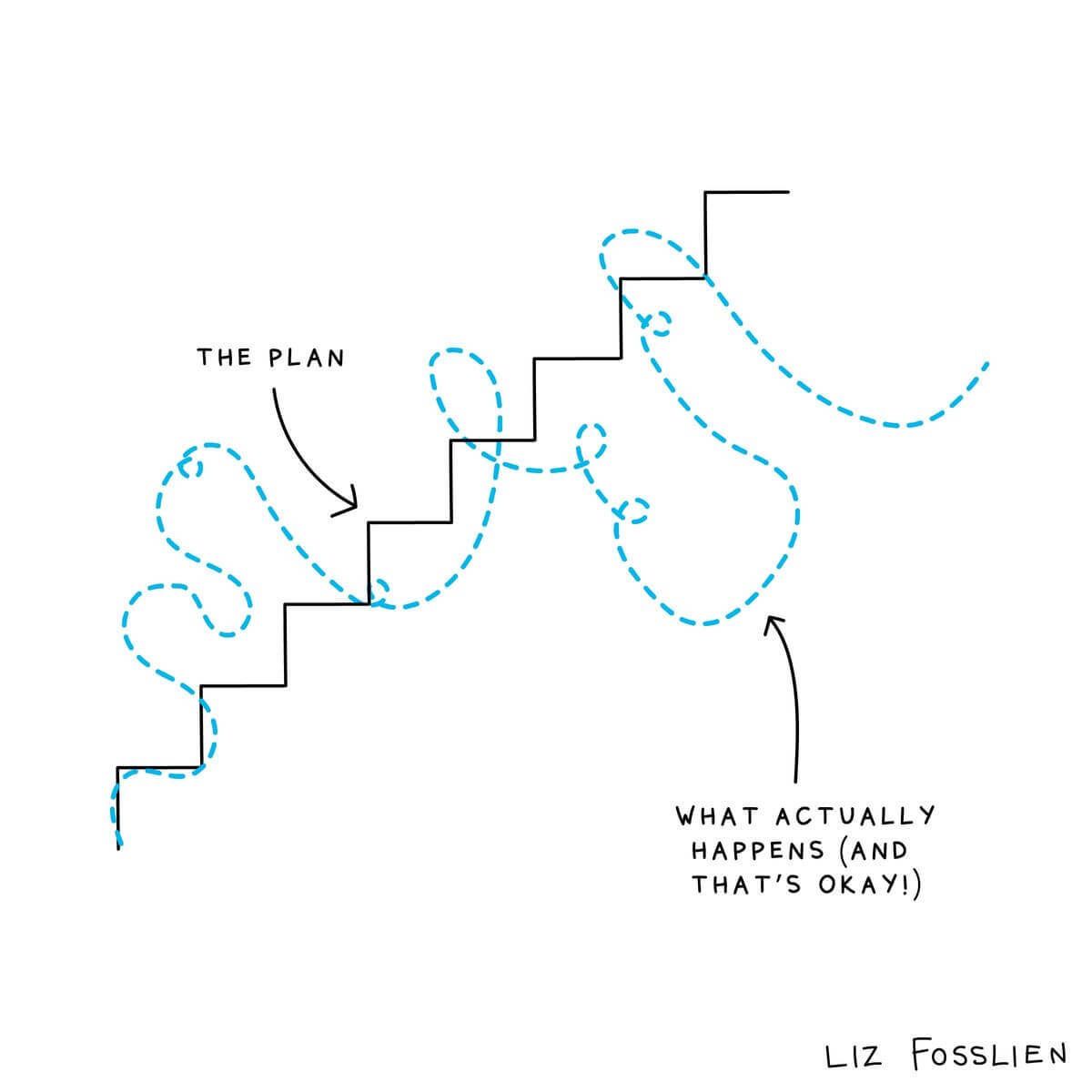
Getting good at something takes a long time, and most of that time doesn't feel like progress. Seth Godin calls this "the Dip" — the long stretch where you're putting in work but don't have much to show for it. Most people quit here. |
The tricky part is that we almost never see other people's Dips. Ricky Gervais created The Office at 40 and it looked like a hit show. What we didn't see was the decades of standup, failed pilots, and radio work underneath it. From the outside, breakthroughs look sudden. From the inside, they're the tail end of years of grinding that nobody was paying attention to. |
This is what makes people in their 30s and 40s think they're behind. You're looking at your own Dip — the messy, uncertain middle — and comparing it to other people's breakthroughs. You're comparing your process to their results. |
 | there’re often big breakouts after the ‘dip’ |
|
🤨 Experience can't be faked |
There's a great quote: in theory, there's no difference between theory and practice. In practice, there is. |
You can read every book on management and still have no idea how to handle your first difficult conversation with a direct report. You can study negotiation tactics and still freeze the first time a client gets aggressive. The knowing and the doing are different skills, and the doing only comes from reps. |
What's easy to miss is that if you've been working for 10-20 years, you already have this. It doesn't feel like a skill because it just feels like how you see the world. |
But it's not how everyone sees the world — it's the product of thousands of small lessons you've absorbed without noticing. And that’s why older people are valuable, and late-blooming is a thing. |
|
🧪 Start with dabbling, not diving |
Most people think reinvention means quitting your job and starting over from scratch. |
In practice, most successful pivots start small. |
I've always loved comedy. Will I ever go full-time comedian? Who knows. But incorporating humor into my work and writing has created opportunities I would've missed if I thought reinvention meant a complete identity change. |
If there's a field or skill you're curious about, take on a side project. Volunteer. Find a mentor who's made a similar transition. Build evidence before making bigger moves. |
|
🤖 AI is shrinking the entry cost |
The stuff that used to make late starts hard — years of training, expensive courses, needing to go back to university — is becoming less of a barrier. |
Building an app used to require years of learning to code. Now you can prototype one in an afternoon (just use Claude Code or ChatGPT Codex!). Making music, editing video, designing a brand — things that used to need years of foundational work before you could even get started are now things you can pick up and try in a weekend. |
The Dip is still real and mastery still takes time. But the cost of just starting — of finding out whether you even like something — has dropped to nearly zero. |
|
🪞 The hardest part is internal! |
The biggest reason people don't reinvent isn't that they can't. It’s that most people are married to their professional identity and don't realise it. |
"I'm a marketing person." "I'm in tech." "I'm not really the creative type." These feel like facts about yourself, but they're just descriptions of what you've been doing recently. Your identity isn't permanent. It just feels that way because you haven't changed it in a while. |
If you play tennis every weekend, you don't refuse to try golf because "I'm a tennis person." But people do exactly this with their careers. |
Two things that help here. |
Optimize your LinkedIn to your new identity — change your headline, rewrite your summary, post about what you're actually interested in now. This tool is awesome for optimizing your profile. People's perception of you adjusts fast. And take a strengths assessment like Coached (try it here) — it gives you language for what you're good at outside your current job title, which makes it easier to see where else you could go.
|
|
|
|
Hopefully that’s a piece of advice you haven’t heard before. If you enjoyed this: |
Forward it to a friend, family member or colleague. It does truly make a difference. If someone you know is on a job search, tell them to check out Resume Worded. It’ll make their job search a lot shorter.
|
Speak soon, |
|
Rohan Mahtani
Founder at Coached & Resume Worded |
Btw, I like reviews. They motivate me to keep the quality high. Like this one: |
| | | |  | Thank you, Joanna - I got back to you w some questions! |
|
| |
| | |
|
You can leave one here. I’d appreciate it. Thank you so much. |
|
A few laughs to keep you smiling until next week |
|
|
|
🤣 BTW: you shouldn’t be writing your cover letter from scratch anymore. Instead, for a real, actually good cover letter, use this AI cover letter tool. It’ll write cover letters that actually have personality and don’t sound like AI — unlike ChatGPT. |
Try it just once for a job you actually want — see how good it is for yourself. |
|
 | not if you read Coached and learn how to manage upwards! like this essay and esp the part about bringing solutions to your bosses is exactly what you need to do |
|
|
 | getting more ‘experienced’ in a nutshell 💀 |
|
How strong is your resume? Find out your resume's score based on millions of real data points |
|
Is your LinkedIn profile getting you rejected? Our AI tool will fix yours in a couple of minutes. |
|
|
|
If you’re new here, join at Coached.com to get the next one. If you want the web version, it’s at the top of my list of essays here. |